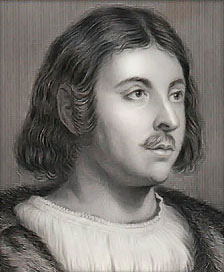
The one, Messer Forese da Rabatta by name, was short and deformed of person and withal flat-cheeked and flat-nosed, insomuch that never a Baroncio (1) had a visage so misshapen but his would have shewed as hideous beside it; yet so conversant was this man with the laws, that by not a few of those well able to form an opinion he was reputed a veritable storehouse of civil jurisprudence. The other, whose name was Giotto, was of so excellent a wit that, let Nature, mother of all, operant ever by continual revolution of the heavens, fashion what she would, he with his style and pen and pencil would depict its like on such wise that it shewed not as its like, but rather as the thing itself, insomuch that the visual sense of men did often err in regard thereof, mistaking for real that which was but painted.
Wherefore, having brought back to light that art which had for many ages lain buried beneath the blunders of those who painted rather to delight the eyes of the ignorant than to satisfy the intelligence of the wise, he may deservedly be called one of the lights that compose the glory of Florence, and the more so, the more lowly was the spirit in which he won that glory, who, albeit he was, while he yet lived, the master of others, yet did ever refuse to be called their master.
And this title that he rejected adorned him with a lustre the more splendid in proportion to the avidity with which it was usurped by those who were less knowing than he, or were his pupils. But for all the exceeding greatness of his art, yet in no particular had he the advantage of Messer Forese either in form or in feature. But to come to the story:—’Twas in Mugello that Messer Forese, as likewise Giotto, had his country-seat, whence returning from a sojourn that he had made there during the summer vacation of the courts, and being, as it chanced, mounted on a poor jade of a draught horse, he fell in with the said Giotto, who was also on his way back to Florence after a like sojourn on his own estate, and was neither better mounted, nor in any other wise better equipped, than Messer Forese.
And so, being both old men, they jogged on together at a slow pace: and being surprised by a sudden shower, such as we frequently see fall in summer, they presently sought shelter in the house of a husbandman that was known to each of them, and was their friend. But after a while, as the rain gave no sign of ceasing, and they had a mind to be at Florence that same day, they borrowed of the husbandman two old cloaks of Romagnole cloth, and two hats much the worse for age (there being no better to be had), and resumed their journey.
Whereon they had not proceeded far, when, taking note that they were soaked through and through, and liberally splashed with the mud cast up by their nags’ hooves (circumstances which are not of a kind to add to one’s dignity), they, after long silence, the sky beginning to brighten a little, began to converse. And Messer Forese, as he rode and hearkened to Giotto, who was an excellent talker, surveyed him sideways, and from head to foot, and all over, and seeing him in all points in so sorry and scurvy a trim, and recking nought of his own appearance, broke into a laugh and said:—”Giotto, would e’er a stranger that met us, and had not seen thee before, believe, thinkst thou, that thou wert, as thou art, the greatest painter in the world.” Whereto Giotto answered promptly:—”Methinks, Sir, he might, if, scanning you, he gave you credit for knowing the A B C.” Which hearing, Messer Forese recognized his error, and perceived that he had gotten as good as he brought.
(1) The name of a Florentine family famous for the extraordinary ugliness of its men: whereby it came to pass that any grotesque or extremely ugly man was called a Baroncio. Fanfani, Vocab. della Lingua Italiana, 1891.
NOVEL VI.
— Michele Scalza proves to certain young men that the Baronci are the best gentlemen in the world and the Maremma, and wins a supper. —
The ladies were still laughing over Giotto’s ready retort, when the queen charged Fiammetta to follow suit; wherefore thus Fiammetta began:—Pamfilo’s mention of the Baronci, who to you, Damsels, are perchance not so well known as to him, has brought to my mind a story in which ’tis shewn how great is their nobility; and, for that it involves no deviation from our rule of discourse, I am minded to tell it you.
‘Tis no long time since there dwelt in our city a young man, Michele Scalza by name, the pleasantest and merriest fellow in the world, and the best furnished with quaint stories: for which reason the Florentine youth set great store on having him with them when they forgathered in company. Now it so befell that one day, he being with a party of them at Mont’ Ughi, they fell a disputing together on this wise; to wit, who were the best gentlemen and of the longest descent in Florence. One said, the Uberti, another, the Lamberti, or some other family, according to the predilection of the speaker. Whereat Scalza began to smile, and said:—”Now out upon you, out upon you, blockheads that ye are: ye know not what ye say.
The best gentlemen and of longest descent in all the world and the Maremma (let alone Florence) are the Baronci by the common consent of all phisopholers,(1) and all that know them as I do; and lest you should otherwise conceive me, I say that ’tis of your neighbours the Baronci(2) of Santa Maria Maggiore that I speak.” Whereupon the young men, who had looked for somewhat else from him, said derisively:—”Thou dost but jest with us; as if we did not know the Baronci as well as thou!” Quoth Scalza:—”By the Gospels I jest not, but speak sooth; and if there is any of you will wager a supper to be given to the winner and six good fellows whom he shall choose, I will gladly do the like, and—what is more—I will abide by the decision of such one of you as you may choose.”
Then said one of them whose name was Neri Mannini:—”I am ready to adventure this supper;” and so they agreed together that Piero di Fiorentino, in whose house they were, should be judge, and hied them to him followed by all the rest, eager to see Scalza lose, and triumph in his discomfiture, and told Piero all that had been said. Piero, who was a young man of sound sense, heard what Neri had to say; and then turning to Scalza:—”And how,” quoth he, “mayst thou make good what thou averrest?” “I will demonstrate it,” returned Scalza, “by reasoning so cogent that not only you, but he that denies it shall acknowledge that I say sooth.
You know, and so they were saying but now, that the longer men’s descent, the better is their gentility, and I say that the Baronci are of longer descent, and thus better gentlemen than any other men. If, then, I prove to you that they are of longer descent than any other men, without a doubt the victory in this dispute will rest with me. Now you must know that when God made the Baronci, He was but a novice in His art, of which, when He made the rest of mankind, He was already master.
And to assure yourself that herein I say sooth, you have but to consider the Baronci, how they differ from the rest of mankind, who all have faces well composed and duly proportioned, whereas of the Baronci you will see one with a face very long and narrow, another with a face inordinately broad, one with a very long nose, another with a short one, one with a protruding and upturned chin, and great jaws like an ass’s; and again there will be one that has one eye larger than its fellow, or set on a lower plane; so that their faces resemble those that children make when they begin to learn to draw.
Whereby, as I said, ’tis plainly manifest that, when God made them, He was but novice in His art; and so they are of longer descent than the rest of mankind, and by consequence better gentlemen.” By which entertaining argument Piero, the judge, and Neri who had wagered the supper, and all the rest, calling to mind the Baronci’s ugliness, were so tickled, that they fell a laughing, and averred that Scalza was in the right, and that he had won the wager, and that without a doubt the Baronci were the best gentlemen, and of the longest descent, not merely in Florence, but in the world and the Maremma to boot. Wherefore ’twas not without reason that Pamfilo, being minded to declare Messer Forese’s ill-favouredness, said that he would have been hideous beside