War and Peace
the pack of cards, put it aside and began rapidly adding up the total of Rostov’s debt, breaking the chalk as he marked the figures in his clear, bold hand.“Supper, it’s time for supper! And here are the gypsies!”
Some swarthy men and women were really entering from the cold outside and saying something in their gypsy accents. Nicholas understood that it was all over; but he said in an indifferent tone:
“Well, won’t you go on? I had a splendid card all ready,” as if it were the fun of the game which interested him most.
“It’s all up! I’m lost!” thought he. “Now a bullet through my brain—that’s all that’s left me!” And at the same time he said in a cheerful voice:
“Come now, just this one more little card!”
“All right!” said Dolokhov, having finished the addition. “All right! Twenty-one rubles,” he said, pointing to the figure twenty-one by which the total exceeded the round sum of forty-three thousand; and taking up a pack he prepared to deal. Rostov submissively unbent the corner of his card and, instead of the six thousand he had intended, carefully wrote twenty-one.
“It’s all the same to me,” he said. “I only want to see whether you will let me win this ten, or beat it.”
Dolokhov began to deal seriously. Oh, how Rostov detested at that moment those hands with their short reddish fingers and hairy wrists, which held him in their power. . . . The ten fell to him.
“You owe forty-three thousand, Count,” said Dolokhov, and stretching himself he rose from the table. “One does get tired sitting so long,” he added.
“Yes, I’m tired too,” said Rostov.
Dolokhov cut him short, as if to remind him that it was not for him to jest.
“When am I to receive the money, Count?”
Rostov, flushing, drew Dolokhov into the next room.
“I cannot pay it all immediately. Will you take an I.O.U.?” he said.
“I say, Rostov,” said Dolokhov clearly, smiling and looking Nicholas straight in the eyes, “you know the saying, ‘Lucky in love, unlucky at cards.’ Your cousin is in love with you, I know.”
“Oh, it’s terrible to feel oneself so in this man’s power,” thought Rostov. He knew what a shock he would inflict on his father and mother by the news of this loss, he knew what a relief it would be to escape it all, and felt that Dolokhov knew that he could save him from all this shame and sorrow, but wanted now to play with him as a cat does with a mouse.
“Your cousin . . .” Dolokhov started to say, but Nicholas interrupted him.
“My cousin has nothing to do with this and it’s not necessary to mention her!” he exclaimed fiercely.
“Then when am I to have it?”
“Tomorrow,” replied Rostov and left the room.
TO SAY “tomorrow” and keep up a dignified tone was not difficult, but to go home alone, see his sisters, brother, mother, and father, confess and ask for money he had no right to after giving his word of honor, was terrible.
At home, they had not yet gone to bed. The young people, after returning from the theater, had had supper and were grouped round the clavichord. As soon as Nicholas entered, he was enfolded in that poetic atmosphere of love which pervaded the Rostov household that winter and, now after Dolokhov’s proposal and Iogel’s ball, seemed to have grown thicker round Sonya and Natasha as the air does before a thunderstorm. Sonya and Natasha, in the light-blue dresses they had worn at the theater, looking pretty and conscious of it, were standing by the clavichord, happy and smiling. Vera was playing chess with Shinshin in the drawing room. The old countess, waiting for the return of her husband and son, sat playing patience with the old gentlewoman who lived in their house. Denisov, with sparkling eyes and ruffled hair, sat at the clavichord striking chords with his short fingers, his legs thrown back and his eyes rolling as he sang, with his small, husky, but true voice, some verses called “Enchantress,” which he had composed, and to which he was trying to fit music:
Enchantress, say, to my forsaken lyre
What magic power is this recalls me still?
What spark has set my inmost soul on fire,
What is this bliss that makes my fingers thrill?
He was singing in passionate tones, gazing with his sparkling black-agate eyes at the frightened and happy Natasha.
“Splendid! Excellent!” exclaimed Natasha. “Another verse,” she said, without noticing Nicholas.
“Everything’s still the same with them,” thought Nicholas, glancing into the drawing room, where he saw Vera and his mother with the old lady.
“Ah, and here’s Nicholas!” cried Natasha, running up to him.
“Is Papa at home?” he asked.
“I am so glad you’ve come!” said Natasha, without answering him. “We are enjoying ourselves! Vasili Dmitrich is staying a day longer for my sake! Did you know?”
“No, Papa is not back yet,” said Sonya.
“Nicholas, have you come? Come here, dear!” called the old countess from the drawing room.
Nicholas went to her, kissed her hand, and sitting down silently at her table began to watch her hands arranging the cards. From the dancing room, they still heard the laughter and merry voices trying to persuade Natasha to sing.
“All wight! All wight!” shouted Denisov. “It’s no good making excuses now! It’s your turn to sing the ba’cawolla—I entweat you!”
The countess glanced at her silent son.
“What is the matter?” she asked.
“Oh, nothing,” said he, as if weary of being continually asked the same question. “Will Papa be back soon?”
“I expect so.”
“Everything’s the same with them. They know nothing about it! Where am I to go?” thought Nicholas, and went again into the dancing room where the clavichord stood.
Sonya was sitting at the clavichord, playing the prelude to Denisov’s favorite barcarolle. Natasha was preparing to sing. Denisov was looking at her with enraptured eyes.
Nicholas began pacing up and down the room.
“Why do they want to make her sing? How can she sing? There’s nothing to be happy about!” thought he.
Sonya struck the first chord of the prelude.
“My God, I’m a ruined and dishonored man! A bullet through my brain is the only thing left me—not singing!” his thoughts ran on. “Go away? But where to? It’s one—let them sing!”
He continued to pace the room, looking gloomily at Denisov and the girls and avoiding their eyes.
“Nikolenka, what is the matter?” Sonya’s eyes fixed on him seemed to ask. She noticed at once that something had happened to him.
Nicholas turned away from her. Natasha too, with her quick instinct, had instantly noticed her brother’s condition. But, though she noticed it, she was herself in such high spirits at that moment, so far from sorrow, sadness, or self-reproach, that she purposely deceived herself as young people often do. “No, I am too happy now to spoil my enjoyment by sympathy with anyone’s sorrow,” she felt, and she said to herself: “No, I must be mistaken, he must be feeling happy, just as I am.”
“Now, Sonya!” she said, going to the very middle of the room, where she considered the resonance was best.
Having lifted her head and let her arms droop lifelessly, as ballet dancers do, Natasha, rising energetically from her heels to her toes, stepped to the middle of the room and stood still.
“Yes, that’s me!” she seemed to say, answering the rapt gaze with which Denisov followed her.
“And what is she so pleased about?” thought Nicholas, looking at his sister. “Why isn’t she dull and ashamed?”
Natasha took the first note, her throat swelled, her chest rose, her eyes became serious. At that moment she was oblivious of her surroundings, and from her smiling lips flowed sounds which anyone may produce at the same intervals and hold for the same time, but which leave you cold a thousand times and the thousand and first time thrill you and make you weep.
Natasha, that winter, had for the first time begun to sing seriously, mainly because Denisov so delighted in her singing. She no longer sang as a child, there was no longer in her singing that comical, childish, painstaking effect that had been in it before; but she did not yet sing well, as all the connoisseurs who heard her said: “It is not trained, but it is a beautiful voice that must be trained.” Only they generally said this some time after she had finished singing. While that untrained voice, with its incorrect breathing and labored transitions, was sounding, even the connoisseurs said nothing, but only delighted in it and wished to hear it again. In her voice there was a virginal freshness, an unconsciousness of her own powers, and an as yet untrained velvety softness, which so mingled with her lack of art in singing that it seemed as if nothing in that voice could be altered without spoiling it.
“What is this?” thought Nicholas, listening to her with widely opened eyes. “What has happened to her? How she is singing today!” And suddenly the whole world centered for him on anticipation of the next note, the next phrase, and everything in the world was divided into three beats: “Oh mio crudele affetto.” . . . One, two, three . . . one, two, three . . . One . . . “Oh mio crudele affetto.” . . . One, two, three . . . One. “Oh, this senseless life of ours!” thought Nicholas. “All this misery, and money, and Dolokhov, and anger, and honor—it’s all nonsense . . . but this is real. . . . Now then, Natasha, now then, dearest! Now then, darling! How will she take that si? She’s taken it! Thank
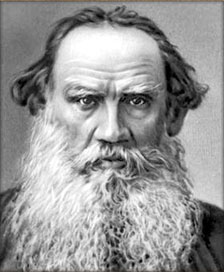
Tolstoy Lev Nikolaevich
(1828—1910s)