War and Peace
of those present, and the advantages that might accrue. He took the seat indicated to him beside the fair Helene and listened to the general conversation.“Vienna considers the bases of the proposed treaty so unattainable that not even a continuity of most brilliant successes would secure them, and she doubts the means we have of gaining them.2 That is the actual phrase used by the Vienna cabinet,” said the Danish charge d’affaires.
“The doubt is flattering,” said “the man of profound intellect,” with a subtle smile.
“We must distinguish between the Vienna cabinet and the Emperor of Austria,” said Mortemart. “The Emperor of Austria can never have thought of such a thing, it is only the cabinet that says it.”
“Ah, my dear vicomte,” put in Anna Pavlovna, “L’Urope” (for some reason she called it Urope as if that were a specially refined French pronunciation which she could allow herself when conversing with a Frenchman), “L’Urope ne sera jamais notre alliee sincere [Europe will never be our sincere ally].”
After that Anna Pavlovna led up to the courage and firmness of the King of Prussia, in order to draw Boris into the conversation.
Boris listened attentively to each of the speakers, awaiting his turn, but managed meanwhile to look round repeatedly at his neighbor, the beautiful Helene, whose eyes several times met those of the handsome young aide-de-camp with a smile.
Speaking of the position of Prussia, Anna Pavlovna very naturally asked Boris to tell them about his journey to Glogau and in what state he found the Prussian army. Boris, speaking with deliberation, told them in pure, correct French many interesting details about the armies and the court, carefully abstaining from expressing an opinion of his own about the facts he was recounting. For some time he engrossed the general attention, and Anna Pavlovna felt that the novelty she had served up was received with pleasure by all her visitors. The greatest attention of all to Boris’ narrative was shown by Helene. She asked him several questions about his journey and seemed greatly interested in the state of the Prussian army. As soon as he had finished she turned to him with her usual smile.
“You absolutely must come and see me,” she said in a tone that implied that, for certain considerations he could not know of, this was absolutely necessary.
“On Tuesday between eight and nine. It will give me great pleasure.”
Boris promised to fulfill her wish and was about to begin a conversation with her, when Anna Pavlovna called him away on the pretext that her aunt wished to hear him.
“You know her husband, of course?” said Anna Pavlovna, closing her eyes and indicating Helene with a sorrowful gesture. “Ah, she is such an unfortunate and charming woman! Don’t mention him before her—please don’t! It is too painful for her!”
- A reference to Moliere’s comedy George Dandin.—A.M.
- Tolstoy has here run rather ahead of the actual course of events. The Bartenstein treaty between Russia and Prussia here spoken of, and to which Austria was invited to adhere, was not concluded till April, 1807, after some actions had taken place, including the battle of Eylau mentioned in the next section, in which Napoleon had so little success that he seemed inclined for peace. Alexander wished to avail himself of this disposition, and in the proposed treaty the Allies made certain stipulations, but Vienna considered it hopeless to propose conditions to Napoleon—who would be sure to reject them. Matters dragged on till May, when Napoleons victory at Friedland put a fresh aspect on affairs. The Bartenstein treaty did not come into operation, but a peace to suit Napoleon was concluded at Tilsit.—A.M.
- Hippolyte at Anna Pávlovna’s
WHEN BORIS and Anna Pavlovna returned to the others Prince Hippolyte had the ear of the company.
Bending forward in his armchair he said: “Le Roi de Prusse!” and having said this laughed. Everyone turned toward him.
“Le Roi de Prusse?” Hippolyte said interrogatively, again laughing, and then calmly and seriously sat back in his chair. Anna Pavlovna waited for him to go on, but as he seemed quite decided to say no more she began to tell of how at Potsdam the impious Bonaparte had stolen the sword of Frederick the Great.
“It is the sword of Frederick the Great which I . . .” she began, but Hippolyte interrupted her with the words: “Le Roi de Prusse . . .” and again, as soon as all turned toward him, excused himself and said no more.
Anna Pavlovna frowned. Mortemart, Hippolyte’s friend, addressed him firmly.
“Come now, what about your Roi de Prusse?”
Hippolyte laughed as if ashamed of laughing.
“Oh, it’s nothing. I only wished to say . . .” (he wanted to repeat a joke he had heard in Vienna and which he had been trying all that evening to get in) “I only wished to say that we are wrong to fight pour le Roi de Prusse!”1
Boris smiled circumspectly, so that it might be taken as ironical or appreciative according to the way the joke was received. Everybody laughed.
“Your joke is too bad, it’s witty but unjust,” said Anna Pavlovna, shaking her little shriveled finger at him.
“We are not fighting pour le Roi de Prusse, but for right principles. Oh, that wicked Prince Hippolyte!” she said.
The conversation did not flag all evening and turned chiefly on the political news. It became particularly animated toward the end of the evening when the rewards bestowed by the Emperor were mentioned.
“You know N— N—received a snuffbox with the portrait last year?” said “the man of profound intellect.” “Why shouldn’t S—S—get the same distinction?”
“Pardon me! A snuffbox with the Emperor’s portrait is a reward but not a distinction,” said the diplomatist—“a gift, rather.”
“There are precedents, I may mention Schwarzenberg.”
“It’s impossible,” replied another.
“Will you bet? The ribbon of the order is a different matter. . . .”
When everybody rose to go, Helene who had spoken very little all the evening again turned to Boris, asking him in a tone of caressing significant command to come to her on Tuesday.
“It is of great importance to me,” she said, turning with a smile toward Anna Pavlovna, and Anna Pavlovna, with the same sad smile with which she spoke of her exalted patroness, supported Helene’s wish.
It seemed as if from some words Boris had spoken that evening about the Prussian army, Helene had suddenly found it necessary to see him. She seemed to promise to explain that necessity to him when he came on Tuesday.
But on Tuesday evening, having come to Helene’s splendid salon, Boris received no clear explanation of why it had been necessary for him to come. There were other guests and the countess talked little to him, and only as he kissed her hand on taking leave said unexpectedly and in a whisper, with a strangely unsmiling face: “Come to dinner tomorrow . . . in the evening. You must come . . . Come!”
During that stay in Petersburg, Boris became an intimate in the countess’ house.
- “For the King of Prussia”—a phrase used in French to denote “for a trifle of no value.”—A.M.
- Old Bolkónski as commander in chief of the conscription. Andrew’s anxiety. A letter from his father
THE WAR was flaming up and nearing the Russian frontier. Everywhere one heard curses on Bonaparte, “the enemy of mankind.” Militiamen and recruits were being enrolled in the villages, and from the seat of war came contradictory news, false as usual and therefore variously interpreted.
The life of old Prince Bolkonski, Prince Andrew, and Princess Mary had greatly changed since 1805.
In 1806 the old prince was made one of the eight commanders in chief then appointed to supervise the enrollment decreed throughout Russia. Despite the weakness of age, which had become particularly noticeable since the time when he thought his son had been killed, he did not think it right to refuse a duty to which he had been appointed by the Emperor himself, and this fresh opportunity for action gave him new energy and strength. He was continually traveling through the three provinces entrusted to him, was pedantic in the fulfillment of his duties, severe to cruel with his subordinates, and went into everything down to the minutest details himself. Princess Mary had ceased taking lessons in mathematics from her father, and when the old prince was at home went to his study with the wet nurse and little Prince Nicholas (as his grandfather called him). The baby Prince Nicholas lived with his wet nurse and nurse Savishna in the late princess’ rooms and Princess Mary spent most of the day in the nursery, taking a mother’s place to her little nephew as best she could. Mademoiselle Bourienne, too, seemed passionately fond of the boy, and Princess Mary often deprived herself to give her friend the pleasure of dandling the little angel—as she called her nephew—and playing with him.
Near the altar of the church at Bald Hills there was a chapel over the tomb of the little princess, and in this chapel was a marble monument brought from Italy, representing an angel with outspread wings ready to fly upwards. The angel’s upper lip was slightly raised as though about to smile, and once on coming out of the chapel Prince Andrew and Princess Mary admitted to one another that the angel’s face reminded them strangely of the little princess. But what was still stranger, though of this Prince Andrew said nothing to his sister, was that in the expression the sculptor had happened to give the angel’s face, Prince Andrew read the same mild reproach he had read on the face of his dead wife: “Ah, why have you done this to me?”
Soon
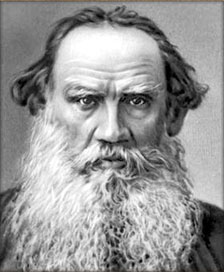
Tolstoy Lev Nikolaevich
(1828—1910s)