War and Peace
defective folk. It was very usual for religious people such as Princess Mary to assist them. They were often harbored at Yasnaya Polyana, especially by Tolstoy’s aunt, Countess A. Osten-Saken.—A.M.
THE PILGRIM WOMAN was appeased and, being encouraged to talk, gave a long account of Father Amphilochus, who led so holy a life that his hands smelled of incense, and how on her last visit to Kiev some monks she knew let her have the keys of the catacombs, and how she, taking some dried bread with her, had spent two days in the catacombs with the saints. “I’d pray awhile to one, ponder awhile, then go on to another. I’d sleep a bit and then again go and kiss the relics, and there was such peace all around, such blessedness, that one don’t want to come out, even into the light of heaven again.”
Pierre listened to her attentively and seriously. Prince Andrew went out of the room, and then, leaving “God’s folk” to finish their tea, Princess Mary took Pierre into the drawing room.
“You are very kind,” she said to him.
“Oh, I really did not mean to hurt her feelings. I understand them so well and have the greatest respect for them.”
Princess Mary looked at him silently and smiled affectionately.
“I have known you a long time, you see, and am as fond of you as of a brother,” she said. “How do you find Andrew?” she added hurriedly, not giving him time to reply to her affectionate words. “I am very anxious about him. His health was better in the winter, but last spring his wound reopened and the doctor said he ought to go away for a cure. And I am also very much afraid for him spiritually. He has not a character like us women who, when we suffer, can weep away our sorrows. He keeps it all within him. Today he is cheerful and in good spirits, but that is the effect of your visit—he is not often like that. If you could persuade him to go abroad. He needs activity, and this quiet regular life is very bad for him. Others don’t notice it, but I see it.”
Toward ten o’clock the men servants rushed to the front door, hearing the bells of the old prince’s carriage approaching. Prince Andrew and Pierre also went out into the porch.
“Who’s that?” asked the old prince, noticing Pierre as he got out of the carriage.
“Ah! Very glad! Kiss me,” he said, having learned who the young stranger was.
The old prince was in a good temper and very gracious to Pierre.
Before supper, Prince Andrew, coming back to his father’s study, found him disputing hotly with his visitor. Pierre was maintaining that a time would come when there would be no more wars. The old prince disputed it chaffingly, but without getting angry.
“Drain the blood from men’s veins and put in water instead, then there will be no more war! Old women’s nonsense—old women’s nonsense!” he repeated, but still he patted Pierre affectionately on the shoulder, and then went up to the table where Prince Andrew, evidently not wishing to join in the conversation, was looking over the papers his father had brought from town. The old prince went up to him and began to talk business.
“The marshal, a Count Rostov, hasn’t sent half his contingent. He came to town and wanted to invite me to dinner—I gave him a pretty dinner! . . . And there, look at this. . . . Well, my boy,” the old prince went on, addressing his son and patting Pierre on the shoulder. “A fine fellow—your friend—I like him! He stirs me up. Another says clever things and one doesn’t care to listen, but this one talks rubbish yet stirs an old fellow up. Well, go! Get along! Perhaps I’ll come and sit with you at supper. We’ll have another dispute. Make friends with my little fool, Princess Mary,” he shouted after Pierre, through the door.
Only now, on his visit to Bald Hills, did Pierre fully realize the strength and charm of his friendship with Prince Andrew. That charm was not expressed so much in his relations with him as with all his family and with the household. With the stern old prince and the gentle, timid Princess Mary, though he had scarcely known them, Pierre at once felt like an old friend. They were all fond of him already. Not only Princess Mary, who had been won by his gentleness with the pilgrims, gave him her most radiant looks, but even the one-year-old “Prince Nicholas” (as his grandfather called him) smiled at Pierre and let himself be taken in his arms, and Michael Ivanovich and Mademoiselle Bourienne looked at him with pleasant smiles when he talked to the old prince.
The old prince came in to supper; this was evidently on Pierre’s account. And during the two days of the young man’s visit he was extremely kind to him and told him to visit them again.
When Pierre had gone and the members of the household met together, they began to express their opinions of him as people always do after a new acquaintance has left, but as seldom happens, no one said anything but what was good of him.
WHEN RETURNING from his leave, Rostov felt, for the first time, how close was the bond that united him to Denisov and the whole regiment.
On approaching it, Rostov felt as he had done when approaching his home in Moscow. When he saw the first hussar with the unbuttoned uniform of his regiment, when he recognized red-haired Dementyev and saw the picket ropes of the roan horses, when Lavrushka gleefully shouted to his master, “The count has come!” and Denisov, who had been asleep on his bed, ran all disheveled out of the mud hut to embrace him, and the officers collected round to greet the new arrival, Rostov experienced the same feeling as when his mother, his father, and his sister had embraced him, and tears of joy choked him so that he could not speak. The regiment was also a home, and as unalterably dear and precious as his parents’ house.
When he had reported himself to the commander of the regiment and had been reassigned to his former squadron, had been on duty and had gone out foraging, when he had again entered into all the little interests of the regiment and felt himself deprived of liberty and bound in one narrow, unchanging frame, he experienced the same sense of peace, of moral support, and the same sense of being at home here in his own place, as he had felt under the parental roof. But here was none of all that turmoil of the world at large, where he did not know his right place and took mistaken decisions; here was no Sonya with whom he ought, or ought not, to have an explanation; here was no possibility of going there or not going there; here there were not twenty-four hours in the day which could be spent in such a variety of ways; there was not that innumerable crowd of people of whom not one was nearer to him or farther from him than another; there were none of those uncertain and undefined money relations with his father, and nothing to recall that terrible loss to Dolokhov. Here, in the regiment, all was clear and simple. The whole world was divided into two unequal parts: one, our Pavlograd regiment; the other, all the rest. And the rest was no concern of his. In the regiment, everything was definite: who was lieutenant, who captain, who was a good fellow, who a bad one, and most of all, who was a comrade. The canteenkeeper gave one credit, one’s pay came every four months, there was nothing to think out or decide, you had only to do nothing that was considered bad in the Pavlograd regiment and, when given an order, to do what was clearly, distinctly, and definitely ordered—and all would be well.
Having once more entered into the definite conditions of this regimental life, Rostov felt the joy and relief a tired man feels on lying down to rest. Life in the regiment, during this campaign, was all the pleasanter for him, because, after his loss to Dolokhov (for which, in spite of all his family’s efforts to console him, he could not forgive himself), he had made up his mind to atone for his fault by serving, not as he had done before, but really well, and by being a perfectly first-rate comrade and officer—in a word, a splendid man altogether, a thing which seemed so difficult out in the world, but so possible in the regiment.
After his losses, he had determined to pay back his debt to his parents in five years. He received ten thousand rubles a year, but now resolved to take only two thousand and leave the rest to repay the debt to his parents.
Our army, after repeated retreats and advances and battles at Pultusk and Preussisch-Eylau, was concentrated near Bartenstein. It was awaiting the Emperor’s arrival and the beginning of a new campaign.
The Pavlograd regiment, belonging to that part of the army which had served in the 1805 campaign, had been recruiting up to strength in Russia, and arrived too late to take part in the first actions of the campaign. It had been neither at Pultusk nor at Preussisch-Eylau and, when it joined the army in the field in the second half of the campaign, was attached to Platov’s division.
Platov’s
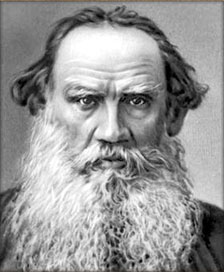
Tolstoy Lev Nikolaevich
(1828—1910s)