War and Peace
division was acting independently of the main army. Several times parts of the Pavlograd regiment had exchanged shots with the enemy, had taken prisoners, and once had even captured Marshal Oudinot’s carriages. In April the Pavlograds were stationed immovably for some weeks near a totally ruined and deserted German village.A thaw had set in, it was muddy and cold, the ice on the river broke, and the roads became impassable. For days neither provisions for the men nor fodder for the horses had been issued.1 As no transports could arrive, the men dispersed about the abandoned and deserted villages, searching for potatoes, but found few even of these.
Everything had been eaten up and the inhabitants had all fled—if any remained, they were worse than beggars and nothing more could be taken from them; even the soldiers, usually pitiless enough, instead of taking anything from them, often gave them the last of their rations.
The Pavlograd regiment had had only two men wounded in action, but had lost nearly half its men from hunger and sickness. In the hospitals, death was so certain that soldiers suffering from fever, or the swelling that came from bad food, preferred to remain on duty, and hardly able to drag their legs went to the front rather than to the hospitals. When spring came on, the soldiers found a plant just showing out of the ground that looked like asparagus, which, for some reason, they called “Mashka’s sweet root.” It was very bitter, but they wandered about the fields seeking it and dug it out with their sabers and ate it, though they were ordered not to do so, as it was a noxious plant. That spring a new disease broke out among the soldiers, a swelling of the arms, legs, and face, which the doctors attributed to eating this root. But in spite of all this, the soldiers of Denisov’s squadron fed chiefly on “Mashka’s sweet root,” because it was the second week that the last of the biscuits were being doled out at the rate of half a pound a man and the last potatoes received had sprouted and frozen.
The horses also had been fed for a fortnight on straw from the thatched roofs and had become terribly thin, though still covered with tufts of felty winter hair.
Despite this destitution, the soldiers and officers went on living just as usual. Despite their pale swollen faces and tattered uniforms, the hussars formed line for roll call, kept things in order, groomed their horses, polished their arms, brought in straw from the thatched roofs in place of fodder, and sat down to dine round the caldrons from which they rose up hungry, joking about their nasty food and their hunger. As usual, in their spare time, they lit bonfires, steamed themselves before them naked; smoked, picked out and baked sprouting rotten potatoes, told and listened to stories of Potemkin’s and Suvorov’s campaigns, or to legends of Alesha the Sly, or the priest’s laborer Mikolka.
The officers, as usual, lived in twos and threes in the roofless, half-ruined houses. The seniors tried to collect straw and potatoes and, in general, food for the men. The younger ones occupied themselves as before, some playing cards (there was plenty of money, though there was no food), some with more innocent games, such as quoits and skittles.2 The general trend of the campaign was rarely spoken of, partly because nothing certain was known about it, partly because there was a vague feeling that in the main it was going badly.
Rostov lived, as before, with Denisov, and since their furlough they had become more friendly than ever. Denisov never spoke of Rostov’s family, but by the tender friendship his commander showed him, Rostov felt that the elder hussar’s luckless love for Natasha played a part in strengthening their friendship. Denisov evidently tried to expose Rostov to danger as seldom as possible, and after an action greeted his safe return with evident joy. On one of his foraging expeditions, in a deserted and ruined village to which he had come in search of provisions, Rostov found a family consisting of an old Pole and his daughter with an infant in arms. They were half clad, hungry, too weak to get away on foot and had no means of obtaining a conveyance. Rostov brought them to his quarters, placed them in his own lodging, and kept them for some weeks while the old man was recovering. One of his comrades, talking of women, began chaffing Rostov, saying that he was more wily than any of them and that it would not be a bad thing if he introduced to them the pretty Polish girl he had saved. Rostov took the joke as an insult, flared up, and said such unpleasant things to the officer that it was all Denisov could do to prevent a duel. When the officer had gone away, Denisov, who did not himself know what Rostov’s relations with the Polish girl might be, began to upbraid him for his quickness of temper, and Rostov replied:
“Say what you like. . . . She is like a sister to me, and I can’t tell you how it offended me . . . because . . . well, for that reason. . . .”
Denisov patted him on the shoulder and began rapidly pacing the room without looking at Rostov, as was his way at moments of deep feeling.
“Ah, what a mad bweed you Wostovs are!” he muttered, and Rostov noticed tears in his eyes.
IN APRIL the troops were enlivened by news of the Emperor’s arrival, but Rostov had no chance of being present at the review he held at Bartenstein, as the Pavlograds were at the outposts far beyond that place.
They were bivouacking. Denisov and Rostov were living in an earth hut, dug out for them by the soldiers and roofed with branches and turf. The hut was made in the following manner, which had then come into vogue. A trench was dug three and a half feet wide, four feet eight inches deep, and eight feet long. At one end of the trench, steps were cut out and these formed the entrance and vestibule. The trench itself was the room, in which the lucky ones, such as the squadron commander, had a board, lying on piles at the end opposite the entrance, to serve as a table. On each side of the trench, the earth was cut out to a breadth of about two and a half feet, and this did duty for bedsteads and couches. The roof was so constructed that one could stand up in the middle of the trench and could even sit up on the beds if one drew close to the table. Denisov, who was living luxuriously because the soldiers of his squadron liked him, had also a board in the roof at the farther end, with a piece of (broken but mended) glass in it for a window. When it was very cold, embers from the soldiers’ campfire were placed on a bent sheet of iron on the steps in the “reception room”—as Denisov called that part of the hut—and it was then so warm that the officers, of whom there were always some with Denisov and Rostov, sat in their shirt sleeves.
In April, Rostov was on orderly duty. One morning, between seven and eight, returning after a sleepless night, he sent for embers, changed his rain-soaked underclothes, said his prayers, drank tea, got warm, then tidied up the things on the table and in his own corner, and, his face glowing from exposure to the wind and with nothing on but his shirt, lay down on his back, putting his arms under his head. He was pleasantly considering the probability of being promoted in a few days for his last reconnoitering expedition, and was awaiting Denisov, who had gone out somewhere and with whom he wanted a talk.
Suddenly he heard Denisov shouting in a vibrating voice behind the hut, evidently much excited. Rostov moved to the window to see whom he was speaking to, and saw the quartermaster, Topcheenko.
“I ordered you not to let them eat that Mashka woot stuff!” Denisov was shouting. “And I saw with my own eyes how Lazarchuk bwought some fwom the fields.”
“I have given the order again and again, your honor, but they don’t obey,” answered the quartermaster.
Rostov lay down again on his bed and thought complacently: “Let him fuss and bustle now, my job’s done and I’m lying down—capitally!” He could hear that Lavrushka—that sly, bold orderly of Denisov’s—was talking, as well as the quartermaster. Lavrushka was saying something about loaded wagons, biscuits,
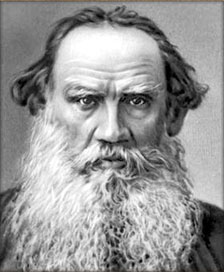
Tolstoy Lev Nikolaevich
(1828—1910s)