War and Peace
the matter stood, he at once produced from under his pillow a paper he had received from the commission and the rough draft of his answer to it. He became animated when he began reading his paper and specially drew Rostov’s attention to the stinging rejoinders he made to his enemies. His hospital companions, who had gathered round Rostov—a fresh arrival from the world outside—gradually began to disperse as soon as Denisov began reading his answer. Rostov noticed by their faces that all those gentlemen had already heard that story more than once and were tired of it. Only the man who had the next bed, a stout Uhlan, continued to sit on his bed, gloomily frowning and smoking a pipe, and little one-armed Tushin still listened, shaking his head disapprovingly. In the middle of the reading, the Uhlan interrupted Denisov.“But what I say is,” he said, turning to Rostov, “it would be best simply to petition the Emperor for pardon. They say great rewards will now be distributed, and surely a pardon would be granted. . . .”
“Me petition the Empewo’!” exclaimed Denisov, in a voice to which he tried hard to give the old energy and fire, but which sounded like an expression of irritable impotence. “What for? If I were a wobber I would ask mercy, but I’m being court-martialed for bwinging wobbers to book. Let them twy me, I’m not afwaid of anyone. I’ve served the Tsar and my countwy honowably and have not stolen! And am I to be degwaded? . . . Listen, I’m w’iting to them stwaight. This is what I say: ‘If I had wobbed the Tweasuwy . . .’ ”
“It’s certainly well written,” said Tushin, “but that’s not the point, Vasili Dmitrich,” and he also turned to Rostov. “One has to submit, and Vasili Dmitrich doesn’t want to. You know the auditor told you it was a bad business.”
“Well, let it be bad,” said Denisov.
“The auditor wrote out a petition for you,” continued Tushin, “and you ought to sign it and ask this gentleman to take it. No doubt he” (indicating Rostov) “has connections on the staff. You won’t find a better opportunity.”
“Haven’t I said I’m not going to gwovel?” Denisov interrupted him, went on reading his paper.
Rostov had not the courage to persuade Denisov, though he instinctively felt that the way advised by Tushin and the other officers was the safest, and though he would have been glad to be of service to Denisov. He knew his stubborn will and straightforward hasty temper.
When the reading of Denisov’s virulent reply, which took more than an hour, was over, Rostov said nothing, and he spent the rest of the day in a most dejected state of mind amid Denisov’s hospital comrades, who had gathered round him, telling them what he knew and listening to their stories. Denisov was moodily silent all the evening.
Late in the evening, when Rostov was about to leave, he asked Denisov whether he had no commission for him.
“Yes, wait a bit,” said Denisov, glancing round at the officers, and taking his papers from under his pillow he went to the window, where he had an inkpot, and sat down to write.
“It seems it’s no use knocking one’s head against a wall!” he said, coming from the window and giving Rostov a large envelope. In it was the petition to the Emperor drawn up by the auditor, in which Denisov, without alluding to the offenses of the commissariat officials, simply asked for pardon.
“Hand it in. It seems . . .”
He did not finish, but gave a painfully unnatural smile.
- Borís at Tilsit Nicholas’ inopportune visit
HAVING RETURNED to the regiment and told the commander the state of Denisov’s affairs, Rostov rode to Tilsit with the letter to the Emperor.
On the thirteenth of June the French and Russian Emperors arrived in Tilsit. Boris Drubetskoy had asked the important personage on whom he was in attendance, to include him in the suite appointed for the stay at Tilsit.
“I should like to see the great man,” he said, alluding to Napoleon, whom hitherto he, like everyone else, had always called Buonaparte.
“You are speaking of Buonaparte?” asked the general, smiling.
Boris looked at his general inquiringly and immediately saw that he was being tested.
“I am speaking, Prince, of the Emperor Napoleon,” he replied. The general patted him on the shoulder, with a smile.
“You will go far,” he said, and took him to Tilsit with him.
Boris was among the few present at the Niemen on the day the two Emperors met. He saw the raft, decorated with monograms, saw Napoleon pass before the French Guards on the farther bank of the river, saw the pensive face of the Emperor Alexander as he sat in silence in a tavern on the bank of the Niemen awaiting Napoleon’s arrival, saw both Emperors get into boats, and saw how Napoleon—reaching the raft first—stepped quickly forward to meet Alexander and held out his hand to him, and how they both retired into the pavilion. Since he had begun to move in the highest circles Boris had made it his habit to watch attentively all that went on around him and to note it down. At the time of the meeting at Tilsit he asked the names of those who had come with Napoleon and about the uniforms they wore, and listened attentively to words spoken by important personages. At the moment the Emperors went into the pavilion he looked at his watch, and did not forget to look at it again when Alexander came out. The interview had lasted an hour and fifty three minutes. He noted this down that same evening, among other facts he felt to be of historic importance. As the Emperor’s suite was a very small one, it was a matter of great importance, for a man who valued his success in the service, to be at Tilsit on the occasion of this interview between the two Emperors, and having succeeded in this, Boris felt that henceforth his position was fully assured. He had not only become known, but people had grown accustomed to him and accepted him. Twice he had executed commissions to the Emperor himself, so that the latter knew his face, and all those at court, far from cold-shouldering him as at first when they considered him a newcomer, would now have been surprised had he been absent.
Boris lodged with another adjutant, the Polish Count Zhilinski. Zhilinski, a Pole brought up in Paris, was rich, and passionately fond of the French, and almost every day of the stay at Tilsit, French officers of the Guard and from French headquarters were dining and lunching with him and Boris.
On the evening of the twenty-fourth of June, Count Zhilinski arranged a supper for his French friends. The guest of honor was an aide-de-camp of Napoleon’s, there were also several French officers of the Guard, and a page of Napoleon’s, a young lad of an old aristocratic French family. That same day, Rostov, profiting by the darkness to avoid being recognized in civilian dress, came to Tilsit and went to the lodging occupied by Boris and Zhilinski.
Rostov, in common with the whole army from which he came, was far from having experienced the change of feeling toward Napoleon and the French—who from being foes had suddenly become friends—that had taken place at headquarters and in Boris. In the army, Bonaparte and the French were still regarded with mingled feelings of anger, contempt, and fear. Only recently, talking with one of Platov’s Cossack officers, Rostov had argued that if Napoleon were taken prisoner he would be treated not as a sovereign, but as a criminal. Quite lately, happening to meet a wounded French colonel on the road, Rostov had maintained with heat that peace was impossible between a legitimate sovereign and the criminal Bonaparte. Rostov was therefore unpleasantly struck by the presence of French officers in Boris’ lodging, dressed in uniforms he had been accustomed to see from quite a different point of view from the outposts of the flank. As soon as he noticed a French officer, who thrust his head out of the door, that warlike feeling of hostility which he always experienced at the sight of the enemy suddenly seized him. He stopped at the threshold and asked in Russian whether Drubetskoy lived there. Boris, hearing a strange voice in the anteroom, came out to meet him. An expression of annoyance showed itself for a moment on his face on first recognizing Rostov.
“Ah, it’s you? Very glad, very glad to see you,” he said, however, coming toward him with a smile. But Rostov had noticed his first impulse.
“I’ve come at a bad time I think. I should not have come, but I have business,” he said coldly.
“No, I only wonder how you managed to get away from your regiment. Dans un moment je suis a vous [In a minute I shall be at your disposal],” he said, answering someone who called him.
“I see I’m intruding,” Rostov repeated.
The look of annoyance had already disappeared from Boris’ face: having evidently reflected and decided how to act, he very quietly took both Rostov’s hands and led him into the next room. His eyes, looking serenely and steadily at Rostov, seemed to be veiled by something, as if screened by blue spectacles of conventionality. So it seemed to Rostov.
“Oh, come now! As if you could come at a wrong time!” said Boris, and he led him into the room where the supper table was laid and introduced him to his guests, explaining that he was not a civilian,
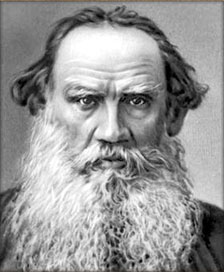
Tolstoy Lev Nikolaevich
(1828—1910s)