War and Peace
hasty steps and the jingling of spurs were heard on the stairs, and the general, leaving him, went to the porch. The gentlemen of the Emperor’s suite ran down the stairs and went to their horses. Hayne, the same groom who had been at Austerlitz, led up the Emperor’s horse, and the faint creak of a footstep Rostov knew at once was heard on the stairs. Forgetting the danger of being recognized, Rostov went close to the porch, together with some inquisitive civilians, and again, after two years, saw those features he adored: that same face and same look and step, and the same union of majesty and mildness. . . . And the feeling of enthusiasm and love for his sovereign rose again in Rostov’s soul in all its old force. In the uniform of the Preobrazhensk regiment—white chamois-leather breeches and high boots—and wearing a star Rostov did not know (it was that of the Legion d’honneur), the monarch came out into the porch, putting on his gloves and carrying his hat under his arm. He stopped and looked about him, brightening everything around by his glance. He spoke a few words to some of the generals, and, recognizing the former commander of Rostov’s division, smiled and beckoned to him.All the suite drew back and Rostov saw the general talking for some time to the Emperor.
The Emperor said a few words to him and took a step toward his horse. Again the crowd of members of the suite and street gazers (among whom was Rostov) moved nearer to the Emperor. Stopping beside his horse, with his hand on the saddle, the Emperor turned to the cavalry general and said in a loud voice, evidently wishing to be heard by all:
“I cannot do it, General. I cannot, because the law is stronger than I,” and he raised his foot to the stirrup.
The general bowed his head respectfully, and the monarch mounted and rode down the street at a gallop. Beside himself with enthusiasm, Rostov ran after him with the crowd.
THE EMPEROR rode to the square where, facing one another, a battalion of the Preobrazhensk regiment stood on the right and a battalion of the French Guards in their bearskin caps on the left.
As the Tsar rode up to one flank of the battalions, which presented arms, another group of horsemen galloped up to the opposite flank, and at the head of them Rostov recognized Napoleon. It could be no one else. He came at a gallop, wearing a small hat, a blue uniform open over a white vest, and the St. Andrew ribbon over his shoulder. He was riding a very fine thoroughbred gray Arab horse with a crimson gold-embroidered saddlecloth. On approaching Alexander he raised his hat, and as he did so, Rostov, with his cavalryman’s eye, could not help noticing that Napoleon did not sit well or firmly in the saddle. The battalions shouted “Hurrah!” and “Vive l’Empereur!” Napoleon said something to Alexander, and both Emperors dismounted and took each other’s hands. Napoleon’s face wore an unpleasant and artificial smile. Alexander was saying something affable to him.
In spite of the trampling of the French gendarmes’ horses, which were pushing back the crowd, Rostov kept his eyes on every movement of Alexander and Bonaparte. It struck him as a surprise that Alexander treated Bonaparte as an equal and that the latter was quite at ease with the Tsar, as if such relations with an Emperor were an everyday matter to him.
Alexander and Napoleon, with the long train of their suites, approached the right flank of the Preobrazhensk battalion and came straight up to the crowd standing there. The crowd unexpectedly found itself so close to the Emperors that Rostov, standing in the front row, was afraid he might be recognized.
“Sire, I ask your permission to present the Legion of Honor to the bravest of your soldiers,” said a sharp, precise voice, articulating every letter.
This was said by the undersized Napoleon, looking up straight into Alexander’s eyes. Alexander listened attentively to what was said to him and, bending his head, smiled pleasantly.
“To him who has borne himself most bravely in this last war,” added Napoleon, accentuating each syllable, as with a composure and assurance exasperating to Rostov, he ran his eyes over the Russian ranks drawn up before him, who all presented arms with their eyes fixed on their Emperor.
“Will Your Majesty allow me to consult the colonel?” said Alexander and took a few hasty steps toward Prince Kozlovski, the commander of the battalion.
Bonaparte meanwhile began taking the glove off his small white hand, tore it in doing so, and threw it away. An aide-de-camp behind him rushed forward and picked it up.
“To whom shall it be given?” the Emperor Alexander asked Koslovski, in Russian in a low voice.
“To whomever Your Majesty commands.”
The Emperor knit his brows with dissatisfaction and, glancing back, remarked:
“But we must give him an answer.”
Kozlovski scanned the ranks resolutely and included Rostov in his scrutiny.
“Can it be me?” thought Rostov.
“Lazarev!” the colonel called, with a frown, and Lazarev, the first soldier in the rank, stepped briskly forward.
“Where are you off to? Stop here!” voices whispered to Lazarev who did not know where to go. Lazarev stopped, casting a sidelong look at his colonel in alarm. His face twitched, as often happens to soldiers called before the ranks.
Napoleon slightly turned his head, and put his plump little hand out behind him as if to take something. The members of his suite, guessing at once what he wanted, moved about and whispered as they passed something from one to another, and a page—the same one Rostov had seen the previous evening at Boris’—ran forward and, bowing respectfully over the outstretched hand and not keeping it waiting a moment, laid in it an Order on a red ribbon. Napoleon, without looking, pressed two fingers together and the badge was between them. Then he approached Lazarev (who rolled his eyes and persistently gazed at his own monarch), looked round at the Emperor Alexander to imply that what he was now doing was done for the sake of his ally, and the small white hand holding the Order touched one of Lazarev’s buttons. It was as if Napoleon knew that it was only necessary for his hand to deign to touch that soldier’s breast for the soldier to be forever happy, rewarded, and distinguished from everyone else in the world. Napoleon merely laid the cross on Lazarev’s breast and, dropping his hand, turned toward Alexander as though sure that the cross would adhere there. And it really did.
Officious hands, Russian and French, immediately seized the cross and fastened it to the uniform. Lazarev glanced morosely at the little man with white hands who was doing something to him and, still standing motionless presenting arms, looked again straight into Alexander’s eyes, as if asking whether he should stand there, or go away, or do something else. But receiving no orders, he remained for some time in that rigid position.
The Emperors remounted and rode away. The Preobrazhensk battalion, breaking rank, mingled with the French Guards and sat down at the tables prepared for them.
Lazarev sat in the place of honor. Russian and French officers embraced him, congratulated him, and pressed his hands. Crowds of officers and civilians drew near merely to see him. A rumble of Russian and French voices and laughter filled the air round the tables in the square. Two officers with flushed faces, looking cheerful and happy, passed by Rostov.
“What d’you think of the treat? All on silver plate,” one of them was saying. “Have you seen Lazarev?”
“I have.”
“Tomorrow, I hear, the Preobrazhenskis will give them a dinner.”1
“Yes, but what luck for Lazarev! Twelve hundred francs’ pension for life.”
“Here’s a cap, lads!” shouted a Preobrazhensk soldier, donning a shaggy French cap.
“It’s a fine thing! First-rate!”
“Have you heard the password?” asked one Guards’ officer of another. “The day before yesterday it was ‘Napoleon, France, bravoure’; yesterday, ‘Alexandre, Russie, grandeur.’ One day our Emperor gives it and next day Napoleon. Tomorrow our Emperor will send a St. George’s Cross to the bravest of the French Guards. It has to be done. He must respond in kind.”
Boris, too, with his friend Zhilinski, came to see the Preobrazhensk banquet. On his way back, he noticed Rostov standing by the corner of a house.
“Rostov! How d’you do? We missed one another,” he said, and could not refrain from asking what was the matter, so strangely dismal and troubled was Rostov’s face.
“Nothing, nothing,” replied Rostov.
“You’ll call round?”
“Yes, I will.”
Rostov stood at that corner for a long time, watching the feast from a distance. In his mind, a painful process was going on which he could not bring to a conclusion. Terrible doubts rose in his soul. Now he remembered Denisov with his changed expression, his submission, and the whole hospital, with arms and legs torn off and its dirt and disease. So vividly did he recall that hospital stench of dead flesh that he looked round to see where the smell came from. Next he thought of that self-satisfied Bonaparte, with his small white hand, who was now an Emperor, liked and respected by Alexander. Then why those severed arms and legs and those dead men? . . . Then again he thought of Lazarev rewarded and Denisov punished and unpardoned. He caught himself harboring such strange thoughts that he was frightened.
The smell of the food the Preobrazhenskis were eating and a sense of hunger recalled him from these reflections; he had to get something to
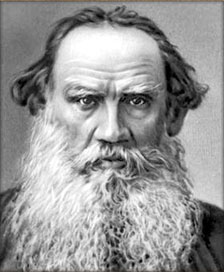
Tolstoy Lev Nikolaevich
(1828—1910s)