War and Peace
eat before going away. He went to a hotel he had noticed that morning. There he found so many people, among them officers who, like himself, had come in civilian clothes, that he had difficulty in getting a dinner. Two officers of his own division joined him. The conversation naturally turned on the peace. The officers, his comrades, like most of the army, were dissatisfied with the peace concluded after the battle of Friedland. They said that had we held out a little longer Napoleon would have been done for, as his troops had neither provisions nor ammunition. Nicholas ate and drank (chiefly the latter) in silence. He finished a couple of bottles of wine by himself. The process in his mind went on tormenting him without reaching a conclusion. He feared to give way to his thoughts, yet could not get rid of them. Suddenly, on one of the officers’ saying that it was humiliating to look at the French, Rostov began shouting with uncalled-for wrath, and therefore much to the surprise of the officers:“How can you judge what’s best?” he cried, the blood suddenly rushing to his face. “How can you judge the Emperor’s actions? What right have we to argue? We cannot comprehend either the Emperor’s aims or his actions!”
“But I never said a word about the Emperor!” said the officer, justifying himself, and unable to understand Rostov’s outburst, except on the supposition that he was drunk.
But Rostov did not listen to him.
“We are not diplomatic officials, we are soldiers and nothing more,” he went on. “If we are ordered to die, we must die. If we’re punished, it means that we have deserved it, it’s not for us to judge. If the Emperor pleases to recognize Bonaparte as Emperor and to conclude an alliance with him, it means that that is the right thing to do. If once we begin judging and arguing about everything, nothing sacred will be left! That way we shall be saying there is no God—nothing!” shouted Nicholas, banging the table—very little to the point as it seemed to his listeners, but quite relevantly to the course of his own thoughts.
“Our business is to do our duty, to fight and not to think! That’s all. . . .” said he.
“And to drink,” said one of the officers, not wishing to quarrel.
“Yes, and to drink,” assented Nicholas. “Hullo there! Another bottle!” he shouted.
BOOK SIX
1808-10
BOOK SIX
- Real Life. Prince Andrew’s occupations at Bogucharovo. His drive through the forest—the bare oak. His visit to the Rostovs at Otradnoe. Overhears Natasha’s talk with Sonya. Return through the forest—the oak in leaf. He decides to go to Petersburg
IN 1808 the Emperor Alexander went to Erfurt for a fresh interview with the Emperor Napoleon, and in the upper circles of Petersburg there was much talk of the grandeur of this important meeting.
In 1809 the intimacy between “the world’s two arbiters,” as Napoleon and Alexander were called, was such that when Napoleon declared war on Austria a Russian corps crossed the frontier to co-operate with our old enemy Bonaparte against our old ally the Emperor of Austria, and in court circles the possibility of marriage between Napoleon and one of Alexander’s sisters was spoken of. But besides considerations of foreign policy, the attention of Russian society was at that time keenly directed on the internal changes that were being undertaken in all the departments of government.
Life meanwhile—real life, with its essential interests of health and sickness, toil and rest, and its intellectual interests in thought, science, poetry, music, love, friendship, hatred, and passions—went on as usual, independently of and apart from political friendship or enmity with Napoleon Bonaparte and from all the schemes of reconstruction.
Prince Andrew had spent two years continuously in the country.
All the plans Pierre had attempted on his estates—and constantly changing from one thing to another had never accomplished—were carried out by Prince Andrew without display and without perceptible difficulty.
He had in the highest degree a practical tenacity which Pierre lacked, and without fuss or strain on his part this set things going.
On one of his estates the three hundred serfs were liberated and became free agricultural laborers—this being one of the first examples of the kind in Russia. On other estates the serfs’ compulsory labor was commuted for a quitrent. A trained midwife was engaged for Bogucharovo at his expense, and a priest was paid to teach reading and writing to the children of the peasants and household serfs.
Prince Andrew spent half his time at Bald Hills with his father and his son, who was still in the care of nurses. The other half he spent in “Bogucharovo Cloister,” as his father called Prince Andrew’s estate. Despite the indifference to the affairs of the world he had expressed to Pierre, he diligently followed all that went on, received many books, and to his surprise noticed that when he or his father had visitors from Petersburg, the very vortex of life, these people lagged behind himself—who never left the country—in knowledge of what was happening in home and foreign affairs.
Besides being occupied with his estates and reading a great variety of books, Prince Andrew was at this time busy with a critical survey of our last two unfortunate campaigns, and with drawing up a proposal for a reform of the army rules and regulations.
In the spring of 1809 he went to visit the Ryazan estates which had been inherited by his son, whose guardian he was.
Warmed by the spring sunshine he sat in the caleche looking at the new grass, the first leaves on the birches, and the first puffs of white spring clouds floating across the clear blue sky. He was not thinking of anything, but looked absent-mindedly and cheerfully from side to side.
They crossed the ferry where he had talked with Pierre the year before. They went through the muddy village, past threshing floors and green fields of winter rye, downhill where snow still lodged near the bridge, uphill where the clay had been liquefied by the rain, past strips of stubble land and bushes touched with green here and there, and into a birch forest growing on both sides of the road. In the forest it was almost hot, no wind could be felt. The birches with their sticky green leaves were motionless, and lilac-colored flowers and the first blades of green grass were pushing up and lifting last year’s leaves. The coarse evergreen color of the small fir trees scattered here and there among the birches was an unpleasant reminder of winter. On entering the forest the horses began to snort and sweated visibly.
Peter the footman made some remark to the coachman; the latter assented. But apparently the coachman’s sympathy was not enough for Peter, and he turned on the box toward his master.
“How pleasant it is, your excellency!” he said with a respectful smile.
“What?”
“It’s pleasant, your excellency!”
“What is he talking about?” thought Prince Andrew. “Oh, the spring, I suppose,” he thought as he turned round. “Yes, really everything is green already. . . . How early! The birches and cherry and alders too are coming out. . . . But the oaks show no sign yet. Ah, here is one oak!”
“Spring, love, happiness!” this oak seemed to say. “Are you not weary of that stupid, meaningless, constantly repeated fraud? Always the same and always a fraud? There is no spring, no sun, no happiness! Look at those cramped dead firs, ever the same, and at me too, sticking out my broken and barked fingers just where they have grown, whether from my back or my sides: as they have grown so I stand, and I do not believe in your hopes and your lies.”
At the edge of the road stood an oak. Probably ten times the age of the birches that formed the forest, it was ten times as thick and twice as tall as they. It was an enormous tree, its girth twice as great as a man could embrace, and evidently long ago some of its branches had been broken off and its bark scarred. With its huge ungainly limbs sprawling unsymmetrically, and its gnarled hands and fingers, it stood an aged, stern, and scornful monster among the smiling birch trees. Only the dead-looking evergreen firs dotted about in the forest, and this oak, refused to yield to the charm of spring or notice either the spring or the sunshine.
As he passed through the forest Prince Andrew turned several times to look at that oak, as if expecting something from it. Under the oak, too, were flowers and grass, but it stood among them scowling, rigid, misshapen, and grim as ever.
“Yes, the oak is right, a thousand times right,” thought Prince Andrew. “Let others—the young—yield afresh to that fraud, but we know life, our life is finished!”
A whole sequence of new thoughts, hopeless but mournfully pleasant, rose in
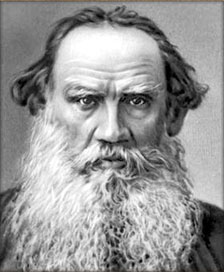
Tolstoy Lev Nikolaevich
(1828—1910s)