War and Peace
a negative concept of not doing what is blameworthy or it is a source of emulation in pursuit of commendation and rewards, which recognize it. His arguments were concise, simple, and clear.“An institution upholding honor, the source of emulation, is one similar to the Legion d’honneur of the great Emperor Napoleon, not harmful but helpful to the success of the service, but not a class or court privilege.”
“I do not dispute that, but it cannot be denied that court privileges have attained the same end,” returned Prince Andrew. “Every courtier considers himself bound to maintain his position worthily.”
“Yet you do not care to avail yourself of the privilege, Prince,” said Speranski, indicating by a smile that he wished to finish amiably an argument which was embarrassing for his companion. “If you will do me the honor of calling on me on Wednesday,” he added, “I will, after talking with Magnitski, let you know what may interest you, and shall also have the pleasure of a more detailed chat with you.”
Closing his eyes, he bowed a la francaise, without taking leave, and trying to attract as little attention as possible, he left the room.
DURING the first weeks of his stay in Petersburg Prince Andrew felt the whole trend of thought he had formed during his life of seclusion quite overshadowed by the trifling cares that engrossed him in that city.
On returning home in the evening he would jot down in his notebook four or five necessary calls or appointments for certain hours. The mechanism of life, the arrangement of the day so as to be in time everywhere, absorbed the greater part of his vital energy. He did nothing, did not even think or find time to think, but only talked, and talked successfully, of what he had thought while in the country.
He sometimes noticed with dissatisfaction that he repeated the same remark on the same day in different circles. But he was so busy for whole days together that he had no time to notice that he was thinking of nothing.
As he had done on their first meeting at Kochubey’s, Speranski produced a strong impression on Prince Andrew on the Wednesday, when he received him tęte-ŕ-tęte at his own house and talked to him long and confidentially.
To Bolkonski so many people appeared contemptible and insignificant creatures, and he so longed to find in someone the living ideal of that perfection toward which he strove, that he readily believed that in Speranski he had found this ideal of a perfectly rational and virtuous man. Had Speranski sprung from the same class as himself and possessed the same breeding and traditions, Bolkonski would soon have discovered his weak, human, unheroic sides; but as it was, Speranski’s strange and logical turn of mind inspired him with respect all the more because he did not quite understand him. Moreover, Speranski, either because he appreciated the other’s capacity or because he considered it necessary to win him to his side, showed off his dispassionate calm reasonableness before Prince Andrew and flattered him with that subtle flattery which goes hand in hand with self-assurance and consists in a tacit assumption that one’s companion is the only man besides oneself capable of understanding the folly of the rest of mankind and the reasonableness and profundity of one’s own ideas.
During their long conversation on Wednesday evening, Speranski more than once remarked: “We regard everything that is above the common level of rooted custom . . .” or, with a smile: “But we want the wolves to be fed and the sheep to be safe . . .” or: “They cannot understand this . . .” and all in a way that seemed to say: “We, you and I, understand what they are and who we are.”
This first long conversation with Speranski only strengthened in Prince Andrew the feeling he had experienced toward him at their first meeting. He saw in him a remarkable, clear-thinking man of vast intellect who by his energy and persistence had attained power, which he was using solely for the welfare of Russia. In Prince Andrew’s eyes Speranski was the man he would himself have wished to be—one who explained all the facts of life reasonably, considered important only what was rational, and was capable of applying the standard of reason to everything. Everything seemed so simple and clear in Speranski’s exposition that Prince Andrew involuntarily agreed with him about everything. If he replied and argued, it was only because he wished to maintain his independence and not submit to Speranski’s opinions entirely. Everything was right and everything was as it should be: only one thing disconcerted Prince Andrew. This was Speranski’s cold, mirrorlike look, which did not allow one to penetrate to his soul, and his delicate white hands, which Prince Andrew involuntarily watched as one does watch the hands of those who possess power. This mirrorlike gaze and those delicate hands irritated Prince Andrew, he knew not why. He was unpleasantly struck, too, by the excessive contempt for others that he observed in Speranski, and by the diversity of lines of argument he used to support his opinions. He made use of every kind of mental device, except analogy, and passed too boldly, it seemed to Prince Andrew, from one to another. Now he would take up the position of a practical man and condemn dreamers; now that of a satirist, and laugh ironically at his opponents; now grow severely logical, or suddenly rise to the realm of metaphysics. (This last resource was one he very frequently employed.) He would transfer a question to metaphysical heights, pass on to definitions of space, time, and thought, and, having deduced the refutation he needed, would again descend to the level of the original discussion.
In general the trait of Speranski’s mentality which struck Prince Andrew most was his absolute and unshakable belief in the power and authority of reason. It was evident that the thought could never occur to him which to Prince Andrew seemed so natural, namely, that it is after all impossible to express all one thinks; and that he had never felt the doubt, “Is not all I think and believe nonsense?” And it was just this peculiarity of Speranski’s mind that particularly attracted Prince Andrew.
During the first period of their acquaintance Bolkonski felt a passionate admiration for him similar to that which he had once felt for Bonaparte. The fact that Speranski was the son of a village priest, and that stupid people might meanly despise him on account of his humble origin (as in fact many did), caused Prince Andrew to cherish his sentiment for him the more, and unconsciously to strengthen it.6
On that first evening Bolkonski spent with him, having mentioned the Commission for the Revision of the Code of Laws, Speranski told him sarcastically that the Commission had existed for a hundred and fifty years, had cost millions, and had done nothing except that Rosenkampf had stuck labels on the corresponding paragraphs of the different codes.
“And that is all the state has for the millions it has spent,” said he. “We want to give the Senate new juridical powers, but we have no laws. That is why it is a sin for men like you, Prince, not to serve in these times!”
Prince Andrew said that for that work an education in jurisprudence was needed which he did not possess.
“But nobody possesses it, so what would you have? It is a vicious circle from which we must break a way out.”
A week later Prince Andrew was a member of the Committee on Army Regulations and—what he had not at all expected—was chairman of a section of the committee for the revision of the laws. At Speranski’s request he took the first part of the Civil Code that was being drawn up and, with the aid of the Code Napoleon and the Institutes of Justinian, he worked at formulating the section on Personal Rights.
NEARLY TWO YEARS before this, in 1808, Pierre on returning to Petersburg after visiting his estates had involuntarily found himself in a leading position among the
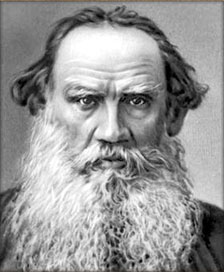
Tolstoy Lev Nikolaevich
(1828—1910s)