War and Peace
furniture and surroundings of human life. Daniel himself felt this, and as usual stood just inside the door, trying to speak softly and not move, for fear of breaking something in the master’s apartment, and he hastened to say all that was necessary so as to get from under that ceiling, out into the open under the sky once more.Having finished his inquiries and extorted from Daniel an opinion that the hounds were fit (Daniel himself wished to go hunting), Nicholas ordered the horses to be saddled. But just as Daniel was about to go Natasha came in with rapid steps, not having done up her hair or finished dressing and with her old nurse’s big shawl wrapped round her. Petya ran in at the same time.
“You are going?” asked Natasha. “I knew you would! Sonya said you wouldn’t go, but I knew that today is the sort of day when you couldn’t help going.”
“Yes, we are going,” replied Nicholas reluctantly, for today, as he intended to hunt seriously, he did not want to take Natasha and Petya. “We are going, but only wolf hunting: it would be dull for you.”
“You know it is my greatest pleasure,” said Natasha. “It’s not fair; you are going by yourself, are having the horses saddled and said nothing to us about it.”
“ ‘No barrier bars a Russian’s path’—we’ll go!” shouted Petya.
“But you can’t. Mamma said you mustn’t,” said Nicholas to Natasha.
“Yes, I’ll go. I shall certainly go,” said Natasha decisively. “Daniel, tell them to saddle for us, and Michael must come with my dogs,” she added to the huntsman.
It seemed to Daniel irksome and improper to be in a room at all, but to have anything to do with a young lady seemed to him impossible. He cast down his eyes and hurried out as if it were none of his business, careful as he went not to inflict any accidental injury on the young lady.
- Readers should bear in mind that the hounds engaged in hunting of the kind here described were keen-scented but not very swift dogs. They had to find the game by scent and chase it in the desired direction, but the swift and strong borzois caught and killed the game. A borzoi has very poor scent and only chases the game when he sees it. It must be pointed out to him, and even when following it he sometimes loses sight of it. If the game shams dead, a borzoi is often balked and hesitates what to do, as in the case mentioned when the hare suddenly squatted and the borzoi did not seize it.—A.M.
- During the writing of War and Peace, Tolstoy was invited by a neighbor to go on an elaborate hunt which probably was the basis for the description of the scenes described on the next few pages.
- The wolf hunt begins
THE OLD COUNT, who had always kept up an enormous hunting establishment but had now handed it all completely over to his son’s care, being in very good spirits on this fifteenth of September, prepared to go out with the others.
In an hour’s time the whole hunting party was at the porch. Nicholas, with a stern and serious air which showed that now was no time for attending to trifles, went past Natasha and Petya who were trying to tell him something. He had a look at all the details of the hunt, sent a pack of hounds and huntsmen on ahead to find the quarry, mounted his chestnut Donets, and whistling to his own leash of borzois, set off across the threshing ground to a field leading to the Otradnoe wood. The old count’s horse, a sorrel gelding called Viflyanka, was led by the groom in attendance on him, while the count himself was to drive in a small trap straight to a spot reserved for him.
They were taking fifty-four hounds, with six hunt attendants and whippers-in. Besides the family, there were eight borzoi kennelmen and more than forty borzois, so that, with the borzois on the leash belonging to members of the family, there were about a hundred and thirty dogs and twenty horsemen.
Each dog knew its master and its call. Each man in the hunt knew his business, his place, what he had to do. As soon as they had passed the fence they all spread out evenly and quietly, without noise or talk, along the road and field leading to the Otradnoe covert.
The horses stepped over the field as over a thick carpet, now and then splashing into puddles as they crossed a road. The misty sky still seemed to descend evenly and imperceptibly toward the earth, the air was still, warm, and silent. Occasionally the whistle of a huntsman, the snort of a horse, the crack of a whip, or the whine of a straggling hound could be heard.
When they had gone a little less than a mile, five more riders with dogs appeared out of the mist, approaching the Rostovs. In front rode a fresh-looking, handsome old man with a large gray mustache.
“Good morning, Uncle!” said Nicholas, when the old man drew near.
“That’s it. Come on! . . . I was sure of it,” began “Uncle.” (He was a distant relative of the Rostovs’, a man of small means, and their neighbor.) “I knew you wouldn’t be able to resist it and it’s a good thing you’re going. That’s it! Come on!” (This was “Uncle’s” favorite expression.) “Take the covert at once, for my Girchik says the Ilagins are at Korniki with their hounds. That’s it. Come on! . . . They’ll take the cubs from under your very nose.”
“That’s where I’m going. Shall we join up our packs?” asked Nicholas.
The hounds were joined into one pack, and “Uncle” and Nicholas rode on side by side. Natasha, muffled up in shawls which did not hide her eager face and shining eyes, galloped up to them. She was followed by Petya who always kept close to her, by Michael, a huntsman, and by a groom appointed to look after her. Petya, who was laughing, whipped and pulled at his horse. Natasha sat easily and confidently on her black Arabchik and reined him in without effort with a firm hand.
“Uncle” looked round disapprovingly at Petya and Natasha. He did not like to combine frivolity with the serious business of hunting.
“Good morning, Uncle! We are going too!” shouted Petya.
“Good morning, good morning! But don’t go overriding the hounds,” said “Uncle” sternly.
“Nicholas, what a fine dog Trunila is! He knew me,” said Natasha, referring to her favorite hound.
“In the first place, Trunila is not a ‘dog,’ but a harrier,” thought Nicholas, and looked sternly at his sister, trying to make her feel the distance that ought to separate them at that moment. Natasha understood it.
“You mustn’t think we’ll be in anyone’s way, Uncle,” she said. “We’ll go to our places and won’t budge.”
“A good thing too, little countess,” said “Uncle,” “only mind you don’t fall off your horse,” he added, “because—that’s it, come on!—you’ve nothing to hold on to.”
The oasis of the Otradnoe covert came in sight a few hundred yards off, the huntsmen were already nearing it. Rostov, having finally settled with “Uncle” where they should set on the hounds, and having shown Natasha where she was to stand—a spot where nothing could possibly run out—went round above the ravine.
“Well, nephew, you’re going for a big wolf,” said “Uncle.” “Mind and don’t let her slip!”
“That’s as may happen,” answered Rostov. “Karay, here!” he shouted, answering “Uncle’s” remark by this call to his borzoi. Karay was a shaggy old dog with a hanging jowl, famous for having tackled a big wolf unaided. They all took up their places.
The old count, knowing his son’s ardor in the hunt, hurried so as not to be late, and the huntsmen had not yet reached their places when Count Ilya Rostov, cheerful, flushed, and with quivering cheeks, drove up with his black horses over the winter rye to the place reserved for him, where a wolf might come out. Having straightened his coat and fastened on his hunting knives and horn, he mounted his good, sleek, well-fed, and comfortable horse, Viflyanka, which was turning gray, like himself. His horses and trap were sent home. Count Ilya Rostov, though not at heart a keen sportsman, knew the rules of the hunt well, and rode to the bushy edge of the road where he was to stand, arranged his reins, settled himself in the saddle, and, feeling that he was ready, looked about with a smile.
Beside him was Simon Chekmar, his personal attendant, an old horseman now somewhat stiff in the saddle. Chekmar held in leash three formidable wolfhounds, who had, however, grown fat like their master and his horse. Two wise old dogs lay down unleashed. Some hundred paces farther along the edge of the wood stood Mitka, the count’s other groom, a daring horseman and keen rider to hounds. Before the hunt, by old custom, the count had drunk a silver cupful of mulled brandy, taken a snack, and washed it down with half a bottle of his favorite Bordeaux.
He was somewhat flushed with the wine and the drive. His eyes were rather moist and glittered more than usual, and as he sat in his saddle, wrapped up in his fur coat, he looked like a child taken out for an outing.
The thin, hollow-cheeked Chekmar, having got everything ready, kept glancing at his master with whom he had lived on the best of terms for thirty years, and understanding the mood he was in expected a pleasant chat.
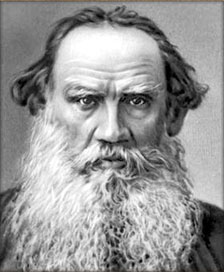
Tolstoy Lev Nikolaevich
(1828—1910s)