War and Peace
A third person rode up circumspectly through the wood (it was plain that he had had a lesson) and stopped behind the count. This person was a gray-bearded old man in a woman’s cloak, with a tall peaked cap on his head. He was the buffoon, who went by a woman’s name, Nastasya Ivanovna.1“Well, Nastasya Ivanovna!” whispered the count, winking at him. “If you scare away the beast, Daniel’ll give it you!”
“I know a thing or two myself!” said Nastasya Ivanovna.
“Hush!” whispered the count and turned to Simon. “Have you seen the young countess?” he asked. “Where is she?”
“With young Count Peter, by the Zharov rank grass,” answered Simon, smiling. “Though she’s a lady, she’s very fond of hunting.”
“And you’re surprised at the way she rides, Simon, eh?” said the count. “She’s as good as many a man!”
“Of course! It’s marvelous. So bold, so easy!”
“And Nicholas? Where is he? By the Lyadov upland, isn’t he?”
“Yes, sir. He knows where to stand. He understands the matter so well that Daniel and I are often quite astounded,” said Simon, well knowing what would please his master.
“Rides well, eh? And how well he looks on his horse, eh?”
“A perfect picture! How he chased a fox out of the rank grass by the Zavarzinsk thicket the other day! Leaped a fearful place; what a sight when they rushed from the covert . . . the horse worth a thousand rubles and the rider beyond all price! Yes, one would have to search far to find another as smart.”
“To search far . . .” repeated the count, evidently sorry Simon had not said more. “To search far,” he said, turning back the skirt of his coat to get at his snuffbox.
“The other day when he came out from Mass in full uniform, Michael Sidorych . . .” Simon did not finish, for on the still air he had distinctly caught the music of the hunt with only two or three hounds giving tongue. He bent down his head and listened, shaking a warning finger at his master. “They are on the scent of the cubs . . .” he whispered, “straight to the Lyadov uplands.”
The count, forgetting to smooth out the smile on his face, looked into the distance straight before him, down the narrow open space, holding the snuffbox in his hand but not taking any. After the cry of the hounds came the deep tones of the wolf call from Daniel’s hunting horn; the pack joined the first three hounds and they could be heard in full cry, with that peculiar lift in the note that indicates that they are after a wolf. The whippers-in no longer set on the hounds, but changed to the cry of ulyulyu, and above the others rose Daniel’s voice, now a deep bass, now piercingly shrill. His voice seemed to fill the whole wood and carried far beyond out into the open field.
After listening a few moments in silence, the count and his attendant convinced themselves that the hounds had separated into two packs: the sound of the larger pack, eagerly giving tongue, began to die away in the distance, the other pack rushed by the wood past the count, and it was with this that Daniel’s voice was heard calling ulyulyu. The sounds of both packs mingled and broke apart again, but both were becoming more distant.
Simon sighed and stooped to straighten the leash a young borzoi had entangled; the count too sighed and, noticing the snuffbox in his hand, opened it and took a pinch. “Back!” cried Simon to a borzoi that was pushing forward out of the wood. The count started and dropped the snuffbox. Nastasya Ivanovna dismounted to pick it up. The count and Simon were looking at him.
Then, unexpectedly, as often happens, the sound of the hunt suddenly approached, as if the hounds in full cry and Daniel ulyulyuing were just in front of them.
The count turned and saw on his right Mitka staring at him with eyes starting out of his head, raising his cap and pointing before him to the other side.
“Look out!” he shouted, in a voice plainly showing that he had long fretted to utter that word, and letting the borzois slip he galloped toward the count.
The count and Simon galloped out of the wood and saw on their left a wolf which, softly swaying from side to side, was coming at a quiet lope farther to the left to the very place where they were standing. The angry borzois whined and getting free of the leash rushed past the horses’ feet at the wolf.
The wolf paused, turned its heavy forehead toward the dogs awkwardly, like a man suffering from the quinsy, and, still slightly swaying from side to side, gave a couple of leaps and with a swish of its tail disappeared into the skirt of the wood. At the same instant, with a cry like a wail, first one hound, then another, and then another, sprang helter-skelter from the wood opposite and the whole pack rushed across the field toward the very spot where the wolf had disappeared. The hazel bushes parted behind the hounds and Daniel’s chestnut horse appeared, dark with sweat. On its long back sat Daniel, hunched forward, capless, his disheveled gray hair hanging over his flushed, perspiring face.
“Ulyulyulyu! ulyulyu! . . .” he cried. When he caught sight of the count his eyes flashed lightning.
“Blast you!” he shouted, holding up his whip threateningly at the count.
“You’ve let the wolf go! . . . What sportsmen!” and as if scorning to say more to the frightened and shamefaced count, he lashed the heaving flanks of his sweating chestnut gelding with all the anger the count had aroused and flew off after the hounds. The count, like a punished schoolboy, looked round, trying by a smile to win Simon’s sympathy for his plight. But Simon was no longer there. He was galloping round by the bushes while the field was coming up on both sides, all trying to head the wolf, but it vanished into the wood before they could do so.
NICHOLAS ROSTOV meanwhile remained at his post, waiting for the wolf. By the way the hunt approached and receded, by the cries of the dogs whose notes were familiar to him, by the way the voices of the huntsmen approached, receded, and rose, he realized what was happening at the copse. He knew that young and old wolves were there, that the hounds had separated into two packs, that somewhere a wolf was being chased, and that something had gone wrong. He expected the wolf to come his way any moment. He made thousands of different conjectures as to where and from what side the beast would come and how he would set upon it. Hope alternated with despair. Several times he addressed a prayer to God that the wolf should come his way. He prayed with that passionate and shamefaced feeling with which men pray at moments of great excitement arising from trivial causes. “What would it be to Thee to do this for me?” he said to God. “I know Thou art great, and that it is a sin to ask this of Thee, but for God’s sake do let the old wolf come my way and let Karay spring at it—in sight of ‘Uncle’ who is watching from over there—and seize it by the throat in a death grip!” A thousand times during that half-hour Rostov cast eager and restless glances over the edge of the wood, with the two scraggy oaks rising above the aspen undergrowth and the gully with its water-worn side and “Uncle’s” cap just visible above the bush on his right.
“No, I shan’t have such luck,” thought Rostov, “yet what wouldn’t it be worth! It is not to be! Everywhere, at cards and in war, I am always unlucky.” Memories of Austerlitz and of Dolokhov flashed rapidly and clearly through his mind. “Only once in my life to get an old wolf, I want only that!” thought he, straining eyes and ears and looking to the left and then to the right and listening to the slightest variation of note in the cries of the dogs.
Again he looked to the right and saw something running toward him across the deserted field. “No, it can’t be!” thought Rostov, taking a deep breath, as a man does at the coming of something long hoped for. The height of happiness was reached—and so simply, without warning, or noise, or display, that Rostov could not believe his eyes and remained in doubt for over a second. The wolf ran forward and jumped heavily over a gully that lay in her path. She was an old animal with a gray back and big reddish belly. She ran without hurry, evidently feeling sure that no one saw her. Rostov, holding his breath, looked round at the borzois. They stood or lay not seeing the wolf or understanding the situation. Old Karay had turned his head and was angrily searching for fleas, baring his yellow teeth and snapping at his hind legs.
“Ulyulyulyu!” whispered Rostov, pouting his lips. The borzois jumped up, jerking the rings of the leashes and pricking their ears. Karay finished scratching his hindquarters and, cocking his ears, got up with quivering tail from which tufts of matted hair hung down.
“Shall I loose them or not?” Nicholas asked himself as the wolf approached him coming from the copse. Suddenly the wolf’s whole physiognomy
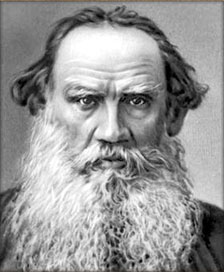
Tolstoy Lev Nikolaevich
(1828—1910s)