War and Peace
a full breast and, looking at the ground flying beneath him and at the sparkling sky, felt himself again in fairyland.“Sonya, is it well with thee?” he asked from time to time.
“Yes!” she replied. “And with thee?”
When halfway home Nicholas handed the reins to the coachman and ran for a moment to Natasha’s sleigh and stood on its wing.
“Natasha!” he whispered in French, “do you know I have made up my mind about Sonya?”
“Have you told her?” asked Natasha, suddenly beaming all over with joy.
“Oh, how strange you are with that mustache and those eyebrows! . . . Natasha—are you glad?”
“I am so glad, so glad! I was beginning to be vexed with you. I did not tell you, but you have been treating her badly. What a heart she has, Nicholas! I am horrid sometimes, but I was ashamed to be happy while Sonya was not,” continued Natasha. “Now I am so glad! Well, run back to her.”
“No, wait a bit. . . . Oh, how funny you look!” cried Nicholas, peering into her face and finding in his sister too something new, unusual, and bewitchingly tender that he had not seen in her before. “Natasha, it’s magical, isn’t it?”
“Yes,” she replied. “You have done splendidly.”
“Had I seen her before as she is now,” thought Nicholas, “I should long ago have asked her what to do and have done whatever she told me, and all would have been well.”
“So you are glad and I have done right?”
“Oh, quite right! I had a quarrel with Mamma some time ago about it. Mamma said she was angling for you. How could she say such a thing! I nearly stormed at Mamma. I will never let anyone say anything bad of Sonya, for there is nothing but good in her.”
“Then it’s all right?” said Nicholas, again scrutinizing the expression of his sister’s face to see if she was in earnest. Then he jumped down and, his boots scrunching the snow, ran back to his sleigh. The same happy, smiling Circassian, with mustache and beaming eyes looking up from under a sable hood, was still sitting there, and that Circassian was Sonya, and that Sonya was certainly his future happy and loving wife.
When they reached home and had told their mother how they had spent the evening at the Melyukovs’, the girls went to their bedroom. When they had undressed, but without washing off the cork mustaches, they sat a long time talking of their happiness. They talked of how they would live when they were married, how their husbands would be friends, and how happy they would be. On Natasha’s table stood two looking glasses which Dunyasha had prepared beforehand.
“Only when will all that be? I am afraid never. . . . It would be too good!” said Natasha, rising and going to the looking glasses.
“Sit down, Natasha; perhaps you’ll see him,” said Sonya.
Natasha lit the candles, one on each side of one of the looking glasses, and sat down.
“I see someone with a mustache,” said Natasha, seeing her own face.
“You mustn’t laugh, Miss,” said Dunyasha.
With Sonya’s help and the maid’s, Natasha got the glass she held into the right position opposite the other; her face assumed a serious expression and she sat silent. She sat a long time looking at the receding line of candles reflected in the glasses and expecting (from tales she had heard) to see a coffin, or him, Prince Andrew, in that last dim, indistinctly outlined square. But ready as she was to take the smallest speck for the image of a man or of a coffin, she saw nothing. She began blinking rapidly and moved away from the looking glasses.
“Why is it others see things and I don’t?” she said. “You sit down now, Sonya. You absolutely must, tonight! Do it for me. . . . Today I feel so frightened!”
Sonya sat down before the glasses, got the right position, and began looking.
“Now, Miss Sonya is sure to see something,” whispered Dunyasha; “while you do nothing but laugh.”
Sonya heard this and Natasha’s whisper:
“I know she will. She saw something last year.”
For about three minutes all were silent.
“Of course she will!” whispered Natasha, but did not finish . . . suddenly Sonya pushed away the glass she was holding and covered her eyes with her hand.
“Oh, Natasha!” she cried.
“Did you see? Did you? What was it?” exclaimed Natasha, holding up the looking glass.
Sonya had not seen anything, she was just wanting to blink and to get up when she heard Natasha say, “Of course she will!” She did not wish to disappoint either Dunyasha or Natasha, but it was hard to sit still. She did not herself know how or why the exclamation escaped her when she covered her eyes.
“You saw him?” urged Natasha, seizing her hand.
“Yes. Wait a bit . . . I . . . saw him,” Sonya could not help saying, not yet knowing whom Natasha meant by him, Nicholas or Prince Andrew.
“But why shouldn’t I say I saw something? Others do see! Besides who can tell whether I saw anything or not?” flashed through Sonya’s mind.
“Yes, I saw him,” she said.
“How? Standing or lying?”
“No, I saw . . . At first there was nothing, then I saw him lying down.”
“Andrew lying? Is he ill?” asked Natasha, her frightened eyes fixed on her friend.
“No, on the contrary, on the contrary! His face was cheerful, and he turned to me.” And when saying this she herself fancied she had really seen what she described.
“Well, and then, Sonya? . . .”
“After that, I could not make out what there was; something blue and red . . .”
“Sonya! When will he come back? When shall I see him! O, God, how afraid I am for him and for myself and about everything! . . .” Natasha began, and without replying to Sonya’s words of comfort she got into bed, and long after her candle was out lay open-eyed and motionless, gazing at the moonlight through the frosty windowpanes.
SOON AFTER THE CHRISTMAS HOLIDAYS Nicholas told his mother of his love for Sonya and of his firm resolve to marry her. The countess, who had long noticed what was going on between them and was expecting this declaration, listened to him in silence and then told her son that he might marry whom he pleased, but that neither she nor his father would give their blessing to such a marriage. Nicholas, for the first time, felt that his mother was displeased with him and that, despite her love for him, she would not give way. Coldly, without looking at her son, she sent for her husband and, when he came, tried briefly and coldly to inform him of the facts, in her son’s presence, but unable to restrain herself she burst into tears of vexation and left the room. The old count began irresolutely to admonish Nicholas and beg him to abandon his purpose. Nicholas replied that he could not go back on his word, and his father, sighing and evidently disconcerted, very soon became silent and went in to the countess. In all his encounters with his son, the count was always conscious of his own guilt toward him for having wasted the family fortune, and so he could not be angry with him for refusing to marry an heiress and choosing the dowerless Sonya. On this occasion, he was only more vividly conscious of the fact that if his affairs had not been in disorder, no better wife for Nicholas than Sonya could have been wished for, and that no one but himself with his Mitenka and his uncomfortable habits was to blame for the condition of the family finances.
The father and mother did not speak of the matter to their son again, but a few days later the countess sent for Sonya and, with a cruelty neither of them expected, reproached her niece for trying to catch Nicholas and for ingratitude. Sonya listened silently with downcast eyes to the countess’ cruel words, without understanding what was required of her. She was ready to sacrifice everything for her benefactors. Self-sacrifice was her most cherished idea but in this case she could not see what she ought to sacrifice, or for whom. She could not help loving the countess and the whole Rostov family, but neither could she help loving Nicholas and knowing that his happiness depended on that love. She was silent and sad and did not reply. Nicholas felt the situation to be intolerable and went to have an explanation with his mother. He first implored her to forgive him and Sonya and consent to their marriage, then he threatened that if she molested Sonya he would at once marry her secretly.
The countess, with a coldness her son had never seen in her before, replied that he was of age, that Prince Andrew was marrying without his father’s consent, and he could do the same, but that she would never receive that intriguer as her daughter.
Exploding at the word intriguer, Nicholas, raising his voice, told his mother he had never expected her to try to force him to sell his feelings, but if that were so, he would say for the last time. . . . But he had no time to utter the decisive word which the expression of his face caused his mother to await with terror, and which would perhaps have forever remained a cruel memory to them both. He had
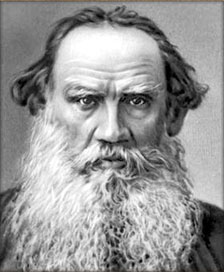
Tolstoy Lev Nikolaevich
(1828—1910s)