War and Peace
maids. “Get the samovar ready! . . . You’ve grown plumper and prettier,” she remarked, drawing Natasha (whose cheeks were glowing from the cold) to her by the hood. “Foo! You are cold! Now take off your things, quick!” she shouted to the count who was going to kiss her hand. “You’re half frozen, I’m sure! Bring some rum for tea! . . . Bonjour, Sonya dear!” she added, turning to Sonya and indicating by this French greeting her slightly contemptuous though affectionate attitude toward her.When they came in to tea, having taken off their outdoor things and tidied themselves up after their journey, Marya Dmitrievna kissed them all in due order.
“I’m heartily glad you have come and are staying with me. It was high time,” she said, giving Natasha a significant look. “The old man is here and his son’s expected any day. You’ll have to make his acquaintance. But we’ll speak of that later on,” she added, glancing at Sonya with a look that showed she did not want to speak of it in her presence. “Now listen,” she said to the count. “What do you want tomorrow? Whom will you send for? Shinshin?” she crooked one of her fingers. “The sniveling Anna Mikhaylovna? That’s two. She’s here with her son. The son is getting married! Then Bezukhov, eh? He is here too, with his wife. He ran away from her and she came galloping after him. He dined with me on Wednesday. As for them”—and she pointed to the girls—“tomorrow I’ll take them first to the Iberian shrine of the Mother of God, and then we’ll drive to the Super-Rogue’s.2 I suppose you’ll have everything new. Don’t judge by me: sleeves nowadays are this size! The other day young Princess Irina Vasilevna came to see me; she was an awful sight—looked as if she had put two barrels on her arms. You know not a day passes now without some new fashion. . . . And what have you to do yourself?” she asked the count sternly.
“One thing has come on top of another: her rags to buy, and now a purchaser has turned up for the Moscow estate and for the house. If you will be so kind, I’ll fix a time and go down to the estate just for a day, and leave my lassies with you.”
“All right. All right. They’ll be safe with me, as safe as in Chancery! I’ll take them where they must go, scold them a bit, and pet them a bit,” said Marya Dmitrievna, touching her goddaughter and favorite, Natasha, on the cheek with her large hand.
Next morning Marya Dmitrievna took the young ladies to the Iberian shrine of the Mother of God and to Madame Suppert-Roguet, who was so afraid of Marya Dmitrievna that she always let her have costumes at a loss merely to get rid of her. Marya Dmitrievna ordered almost the whole trousseau. When they got home she turned everybody out of the room except Natasha, and then called her pet to her armchair.
“Well, now we’ll talk. I congratulate you on your betrothed. You’ve hooked a fine fellow! I am glad for your sake and I’ve known him since he was so high.” She held her hand a couple of feet from the ground. Natasha blushed happily. “I like him and all his family. Now listen! You know that old Prince Nicholas much dislikes his son’s marrying. The old fellow’s crotchety! Of course Prince Andrew is not a child and can shift without him, but it’s not nice to enter a family against a father’s will. One wants to do it peacefully and lovingly. You’re a clever girl and you’ll know how to manage. Be kind, and use your wits. Then all will be well.”
Natasha remained silent, from shyness Marya Dmitrievna supposed, but really because she disliked anyone interfering in what touched her love of Prince Andrew, which seemed to her so apart from all human affairs that no one could understand it. She loved and knew Prince Andrew, he loved her only, and was to come one of these days and take her. She wanted nothing more.
“You see I have known him a long time and am also fond of Mary, your future sister-in-law. ‘Husbands’ sisters bring up blisters,’ but this one wouldn’t hurt a fly. She has asked me to bring you two together. Tomorrow you’ll go with your father to see her. Be very nice and affectionate to her: you’re younger than she. When he comes, he’ll find you already know his sister and father and are liked by them. Am I right or not? Won’t that be best?”
“Yes, it will,” Natasha answered reluctantly.
NEXT DAY, by Marya Dmitrievna’s advice, Count Rostov took Natasha to call on Prince Nicholas Bolkonski. The count did not set out cheerfully on this visit, at heart he felt afraid. He well remembered the last interview he had had with the old prince at the time of the enrollment, when in reply to an invitation to dinner he had had to listen to an angry reprimand for not having provided his full quota of men. Natasha, on the other hand, having put on her best gown, was in the highest spirits. “They can’t help liking me,” she thought. “Everybody always has liked me, and I am so willing to do anything they wish, so ready to be fond of him—for being his father—and of her—for being his sister—that there is no reason for them not to like me . . .”
They drove up to the gloomy old house on the Vozdvizhenka and entered the vestibule.
“Well, the Lord have mercy on us!” said the count, half in jest, half in earnest; but Natasha noticed that her father was flurried on entering the anteroom and inquired timidly and softly whether the prince and princess were at home.
When they had been announced a perturbation was noticeable among the servants. The footman who had gone to announce them was stopped by another in the large hall and they whispered to one another. Then a maidservant ran into the hall and hurriedly said something, mentioning the princess. At last an old, cross looking footman came and announced to the Rostovs that the prince was not receiving, but that the princess begged them to walk up. The first person who came to meet the visitors was Mademoiselle Bourienne. She greeted the father and daughter with special politeness and showed them to the princess’ room. The princess, looking excited and nervous, her face flushed in patches, ran in to meet the visitors, treading heavily, and vainly trying to appear cordial and at ease. From the first glance Princess Mary did not like Natasha. She thought her too fashionably dressed, frivolously gay and vain. She did not at all realize that before having seen her future sister-in-law she was prejudiced against her by involuntary envy of her beauty, youth, and happiness, as well as by jealousy of her brother’s love for her. Apart from this insuperable antipathy to her, Princess Mary was agitated just then because on the Rostovs’ being announced, the old prince had shouted that he did not wish to see them, that Princess Mary might do so if she chose, but they were not to be admitted to him. She had decided to receive them, but feared lest the prince might at any moment indulge in some freak, as he seemed much upset by the Rostovs’ visit.
“There, my dear princess, I’ve brought you my songstress,” said the count, bowing and looking round uneasily as if afraid the old prince might appear. “I am so glad you should get to know one another . . . very sorry the prince is still ailing,” and after a few more commonplace remarks he rose. “If you’ll allow me to leave my Natasha in your hands for a quarter of an hour, Princess, I’ll drive round to see Anna Semenovna, it’s quite near in the Dogs’ Square, and then I’ll come back for her.”
The count had devised this diplomatic ruse (as he afterwards told his daughter) to give the future sisters-in-law an opportunity to talk to one another freely, but another motive was to avoid the danger of encountering the old prince, of whom he was afraid. He did not mention this to his daughter, but Natasha noticed her father’s nervousness and anxiety and felt mortified by it. She blushed for him, grew still angrier at having blushed, and looked at the princess with a bold and defiant expression which said that she was not afraid of anybody. The princess told the count that she would be delighted, and only begged him to stay longer at Anna Semenovna’s, and he departed.
Despite the uneasy glances thrown at her by Princess Mary—who wished to have a tęte-ŕ-tęte with Natasha—Mademoiselle Bourienne remained in the room and persistently talked about Moscow amusements and theaters. Natasha felt offended by the hesitation she had noticed in the anteroom, by her father’s nervousness, and by the unnatural manner of the princess who—she thought—was making a favor of receiving her, and so everything displeased her. She did not like Princess Mary, whom she thought very plain, affected, and dry. Natasha suddenly shrank into herself and involuntarily assumed an offhand air which alienated
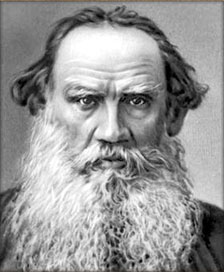
Tolstoy Lev Nikolaevich
(1828—1910s)