War and Peace
Oh, better not think of it—not till he comes back!” she told herself, and began looking at the faces, some strange and some familiar, in the stalls. In the front, in the very center, leaning back against the orchestra rail, stood Dolokhov in a Persian dress, his curly hair brushed up into a huge shock. He stood in full view of the audience, well aware that he was attracting everyone’s attention, yet as much at ease as though he were in his own room. Around him thronged Moscow’s most brilliant young men, whom he evidently dominated.The count, laughing, nudged the blushing Sonya and pointed to her former adorer.
“Do you recognize him?” said he. “And where has he sprung from?” he asked, turning to Shinshin. “Didn’t he vanish somewhere?”
“He did,” replied Shinshin. “He was in the Caucasus and ran away from there. They say he has been acting as minister to some ruling prince in Persia, where he killed the Shah’s brother. Now all the Moscow ladies are mad about him! It’s ‘Dolokhov the Persian’ that does it! We never hear a word but Dolokhov is mentioned. They swear by him, they offer him to you as they would a dish of choice sterlet. Dolokhov and Anatole Kuragin have turned all our ladies’ heads.”
A tall, beautiful woman with a mass of plaited hair and much exposed plump white shoulders and neck, round which she wore a double string of large pearls, entered the adjoining box rustling her heavy silk dress and took a long time settling into her place.
Natasha involuntarily gazed at that neck, those shoulders, and pearls and coiffure, and admired the beauty of the shoulders and the pearls. While Natasha was fixing her gaze on her for the second time the lady looked round and, meeting the count’s eyes, nodded to him and smiled. She was the Countess Bezukhova, Pierre’s wife, and the count, who knew everyone in society, leaned over and spoke to her.
“Have you been here long, Countess?” he inquired. “I’ll call, I’ll call to kiss your hand. I’m here on business and have brought my girls with me. They say Semenova acts marvelously.1 Count Pierre never used to forget us. Is he here?”
“Yes, he meant to look in,” answered Helene, and glanced attentively at Natasha.
Count Rostov resumed his seat.
“Handsome, isn’t she?” he whispered to Natasha.
“Wonderful!” answered Natasha. “She’s a woman one could easily fall in love with.”
Just then the last chords of the overture were heard and the conductor tapped with his stick. Some latecomers took their seats in the stalls, and the curtain rose.
As soon as it rose everyone in the boxes and stalls became silent, and all the men, old and young, in uniform and evening dress, and all the women with gems on their bare flesh, turned their whole attention with eager curiosity to the stage. Natasha too began to look at it.
THE FLOOR OF THE STAGE consisted of smooth boards, at the sides was some painted cardboard representing trees, and at the back was a cloth stretched over boards.1 In the center of the stage sat some girls in red bodices and white skirts. One very fat girl in a white silk dress sat apart on a low bench, to the back of which a piece of green cardboard was glued. They all sang something. When they had finished their song the girl in white went up to the prompter’s box and a man with tight silk trousers over his stout legs, and holding a plume and a dagger, went up to her and began singing, waving his arms about.
First the man in the tight trousers sang alone, then she sang, then they both paused while the orchestra played and the man fingered the hand of the girl in white, obviously awaiting the beat to start singing with her. They sang together and everyone in the theater began clapping and shouting, while the man and woman on the stage—who represented lovers—began smiling, spreading out their arms, and bowing.
After her life in the country, and in her present serious mood, all this seemed grotesque and amazing to Natasha. She could not follow the opera nor even listen to the music; she saw only the painted cardboard and the queerly dressed men and women who moved, spoke, and sang so strangely in that brilliant light. She knew what it was all meant to represent, but it was so pretentiously false and unnatural that she first felt ashamed for the actors and then amused at them. She looked at the faces of the audience, seeking in them the same sense of ridicule and perplexity she herself experienced, but they all seemed attentive to what was happening on the stage, and expressed delight which to Natasha seemed feigned. “I suppose it has to be like this!” she thought. She kept looking round in turn at the rows of pomaded heads in the stalls and then at the seminude women in the boxes, especially at Helene in the next box, who—apparently quite unclothed—sat with a quiet tranquil smile, not taking her eyes off the stage. And feeling the bright light that flooded the whole place and the warm air heated by the crowd, Natasha little by little began to pass into a state of intoxication she had not experienced for a long while. She did not realize who and where she was, nor what was going on before her. As she looked and thought, the strangest fancies unexpectedly and disconnectedly passed through her mind: the idea occurred to her of jumping onto the edge of the box and singing the air the actress was singing, then she wished to touch with her fan an old gentleman sitting not far from her, then to lean over to Helene and tickle her.
At a moment when all was quiet before the commencement of a song, a door leading to the stalls on the side nearest the Rostovs’ box creaked, and the steps of a belated arrival were heard. “There’s Kuragin!” whispered Shinshin. Countess Bezukhova turned smiling to the newcomer, and Natasha, following the direction of that look, saw an exceptionally handsome adjutant approaching their box with a self-assured yet courteous bearing. This was Anatole Kuragin whom she had seen and noticed long ago at the ball in Petersburg. He was now in an adjutant’s uniform with one epaulet and a shoulder knot. He moved with a restrained swagger which would have been ridiculous had he not been so good-looking and had his handsome face not worn such an expression of good-humored complacency and gaiety. Though the performance was proceeding, he walked deliberately down the carpeted gangway, his sword and spurs slightly jingling and his handsome perfumed head held high. Having looked at Natasha he approached his sister, laid his well gloved hand on the edge of her box, nodded to her, and leaning forward asked a question, with a motion toward Natasha.
“Mais charmante!” said he, evidently referring to Natasha, who did not exactly hear his words but understood them from the movement of his lips. Then he took his place in the first row of the stalls and sat down beside Dolokhov, nudging with his elbow in a friendly and offhand way that Dolokhov whom others treated so fawningly. He winked at him gaily, smiled, and rested his foot against the orchestra screen.
“How like the brother is to the sister,” remarked the count. “And how handsome they both are!”
Shinshin, lowering his voice, began to tell the count of some intrigue of Kuragin’s in Moscow, and Natasha tried to overhear it just because he had said she was “charmante.”
The first act was over. In the stalls everyone began moving about, going out and coming in.
Boris came to the Rostovs’ box, received their congratulations very simply, and raising his eyebrows with an absent-minded smile conveyed to Natasha and Sonya his fiancee’s invitation to her wedding, and went away. Natasha with a gay, coquettish smile talked to him, and congratulated on his approaching wedding that same Boris with whom she had formerly been in love. In the state of intoxication she was in, everything seemed simple and natural.
The scantily clad Helene smiled at everyone in the same way, and Natasha gave Boris a similar smile.
Helene’s box was filled and surrounded from the stalls by the most distinguished and intellectual men, who seemed to vie with one another in their wish to let everyone see that they knew her.
During the whole of that entr’acte Kuragin stood with Dolokhov in front of the orchestra partition, looking at the Rostovs’ box. Natasha knew he was talking about her and this afforded her pleasure. She even turned so that he should see her profile in what she thought was its most becoming aspect. Before the beginning of the second act Pierre appeared in the stalls. The Rostovs had not seen him since their arrival. His face looked sad, and he had grown still stouter since Natasha last saw him. He passed up to the front rows, not noticing anyone. Anatole went up to him and began speaking to him, looking at and indicating the Rostovs’ box. On seeing Natasha Pierre grew animated and, hastily passing between the rows, came toward their box. When he got
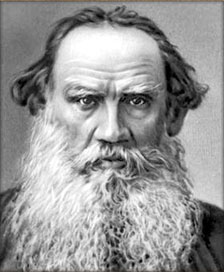
Tolstoy Lev Nikolaevich
(1828—1910s)