War and Peace
there he leaned on his elbows and, smiling, talked to her for a long time. While conversing with Pierre, Natasha heard a man’s voice in Countess Bezukhova’s box and something told her it was Kuragin. She turned and their eyes met. Almost smiling, he gazed straight into her eyes with such an enraptured caressing look that it seemed strange to be so near him, to look at him like that, to be so sure he admired her, and not to be acquainted with him.In the second act there was scenery representing tombstones, there was a round hole in the canvas to represent the moon, shades were raised over the footlights, and from horns and contrabass came deep notes while many people appeared from right and left wearing black cloaks and holding things like daggers in their hands. They began waving their arms. Then some other people ran in and began dragging away the maiden who had been in white and was now in light blue. They did not drag her away at once, but sang with her for a long time and then at last dragged her off, and behind the scenes something metallic was struck three times and everyone knelt down and sang a prayer. All these things were repeatedly interrupted by the enthusiastic shouts of the audience.
During this act every time Natasha looked toward the stalls she saw Anatole Kuragin with an arm thrown across the back of his chair, staring at her. She was pleased to see that he was captivated by her and it did not occur to her that there was anything wrong in it.
When the second act was over Countess Bezukhova rose, turned to the Rostovs’ box—her whole bosom completely exposed—beckoned the old count with a gloved finger, and paying no attention to those who had entered her box began talking to him with an amiable smile.
“Do make me acquainted with your charming daughters,” said she. “The whole town is singing their praises and I don’t even know them!”
Natasha rose and curtsied to the splendid countess. She was so pleased by praise from this brilliant beauty that she blushed with pleasure.
“I want to become a Moscovite too, now,” said Helene. “How is it you’re not ashamed to bury such pearls in the country?”
Countess Bezukhova quite deserved her reputation of being a fascinating woman. She could say what she did not think—especially what was flattering—quite simply and naturally.
“Dear count, you must let me look after your daughters! Though I am not staying here long this time—nor are you—I will try to amuse them. I have already heard much of you in Petersburg and wanted to get to know you,” said she to Natasha with her stereotyped and lovely smile. “I had heard about you from my page, Drubetskoy. Have you heard he is getting married? And also from my husband’s friend Bolkonski, Prince Andrew Bolkonski,” she went on with special emphasis, implying that she knew of his relation to Natasha. To get better acquainted she asked that one of the young ladies should come into her box for the rest of the performance, and Natasha moved over to it.
The scene of the third act represented a palace in which many candles were burning and pictures of knights with short beards hung on the walls. In the middle stood what were probably a king and a queen. The king waved his right arm and, evidently nervous, sang something badly and sat down on a crimson throne. The maiden who had been first in white and then in light blue, now wore only a smock, and stood beside the throne with her hair down. She sang something mournfully, addressing the queen, but the king waved his arm severely, and men and women with bare legs came in from both sides and began dancing all together. Then the violins played very shrilly and merrily and one of the women with thick bare legs and thin arms, separating from the others, went behind the wings, adjusted her bodice, returned to the middle of the stage, and began jumping and striking one foot rapidly against the other. In the stalls everyone clapped and shouted “bravo!” Then one of the men went into a corner of the stage. The cymbals and horns in the orchestra struck up more loudly, and this man with bare legs jumped very high and waved his feet about very rapidly. (He was Duport, who received sixty thousand rubles a year for this art.) Everybody in the stalls, boxes, and galleries began clapping and shouting with all their might, and the man stopped and began smiling and bowing to all sides. Then other men and women danced with bare legs. Then the king again shouted to the sound of music, and they all began singing. But suddenly a storm came on, chromatic scales and diminished sevenths were heard in the orchestra, everyone ran off, again dragging one of their number away, and the curtain dropped. Once more there was a terrible noise and clatter among the audience, and with rapturous faces everyone began shouting: “Duport! Duport! Duport!” Natasha no longer thought this strange. She looked about with pleasure, smiling joyfully.
“Isn’t Duport delightful?” Helene asked her.
“Oh, yes,” replied Natasha.
DURING THE entr’acte a whiff of cold air came into Helene’s box, the door opened, and Anatole entered, stooping and trying not to brush against anyone.
“Let me introduce my brother to you,” said Helene, her eyes shifting uneasily from Natasha to Anatole.
Natasha turned her pretty little head toward the elegant young officer and smiled at him over her bare shoulder. Anatole, who was as handsome at close quarters as at a distance, sat down beside her and told her he had long wished to have this happiness—ever since the Naryshkins’ ball in fact, at which he had had the well-remembered pleasure of seeing her. Kuragin was much more sensible and simple with women than among men. He talked boldly and naturally, and Natasha was strangely and agreeably struck by the fact that there was nothing formidable in this man about whom there was so much talk, but that on the contrary his smile was most naive, cheerful, and good-natured.
Kuragin asked her opinion of the performance and told her how at a previous performance Semenova had fallen down on the stage.
“And do you know, Countess,” he said, suddenly addressing her as an old, familiar acquaintance, “we are getting up a costume tournament; you ought to take part in it! It will be great fun. We shall all meet at the Karagins’! Please come! No! Really, eh?” said he.
While saying this he never removed his smiling eyes from her face, her neck, and her bare arms. Natasha knew for certain that he was enraptured by her. This pleased her, yet his presence made her feel constrained and oppressed. When she was not looking at him she felt that he was looking at her shoulders, and she involuntarily caught his eye so that he should look into hers rather than this. But looking into his eyes she was frightened, realizing that there was not that barrier of modesty she had always felt between herself and other men. She did not know how it was that within five minutes she had come to feel herself terribly near to this man. When she turned away she feared he might seize her from behind by her bare arm and kiss her on the neck. They spoke of most ordinary things, yet she felt that they were closer to one another than she had ever been to any man. Natasha kept turning to Helene and to her father, as if asking what it all meant, but Helene was engaged in conversation with a general and did not answer her look, and her father’s eyes said nothing but what they always said: “Having a good time? Well, I’m glad of it!”
During one of these moments of awkward silence when Anatole’s prominent eyes were gazing calmly and fixedly at her, Natasha, to break the silence, asked him how he liked Moscow. She asked the question and blushed. She felt all the time that by talking to him she was doing something improper. Anatole smiled as though to encourage her.
“At first I did not like it much, because what makes a town pleasant ce sont les jolies femmes [Are the pretty women], isn’t that so? But now I like it very much indeed,” he said, looking at her significantly. “You’ll come to the costume tournament, Countess? Do come!” and putting out his hand to her bouquet and dropping his voice, he added, “You will be the prettiest there. Do come, dear countess, and give me this flower as a pledge!”
Natasha did not understand what he was saying any more than he did himself, but she felt that his incomprehensible words had an improper intention. She did not know what to say and turned away as if she had not heard his remark. But as soon as she had turned away she felt that he was there, behind, so close behind her.
“How is he now? Confused? Angry? Ought I to put it right?” she asked herself, and she could not refrain from turning round. She looked
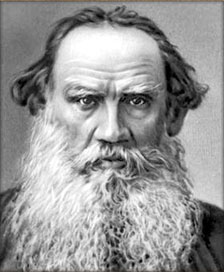
Tolstoy Lev Nikolaevich
(1828—1910s)