War and Peace
straight into his eyes, and his nearness, self-assurance, and the good-natured tenderness of his smile vanquished her. She smiled just as he was doing, gazing straight into his eyes. And again she felt with horror that no barrier lay between him and her.The curtain rose again. Anatole left the box, serene and gay. Natasha went back to her father in the other box, now quite submissive to the world she found herself in. All that was going on before her now seemed quite natural, but on the other hand all her previous thoughts of her betrothed, of Princess Mary, or of life in the country did not once recur to her mind and were as if belonging to a remote past.
In the fourth act there was some sort of devil who sang waving his arm about, till the boards were withdrawn from under him and he disappeared down below. That was the only part of the fourth act that Natasha saw. She felt agitated and tormented, and the cause of this was Kuragin whom she could not help watching. As they were leaving the theater Anatole came up to them, called their carriage, and helped them in. As he was putting Natasha in he pressed her arm above the elbow. Agitated and flushed she turned round. He was looking at her with glittering eyes, smiling tenderly.
Only after she had reached home was Natasha able clearly to think over what had happened to her, and suddenly remembering Prince Andrew she was horrified, and at tea to which all had sat down after the opera, she gave a loud exclamation, flushed, and ran out of the room.
“O God! I am lost!” she said to herself. “How could I let him?” She sat for a long time hiding her flushed face in her hands trying to realize what had happened to her, but was unable either to understand what had happened or what she felt. Everything seemed dark, obscure, and terrible. There in that enormous, illuminated theater where the bare-legged Duport, in a tinsel-decorated jacket, jumped about to the music on wet boards, and young girls and old men, and the nearly naked Helene with her proud, calm smile, rapturously cried “bravo!”—there in the presence of that Helene it had all seemed clear and simple; but now, alone by herself, it was incomprehensible. “What is it? What was that terror I felt of him? What is this gnawing of conscience I am feeling now?” she thought.
Only to the old countess at night in bed could Natasha have told all she was feeling. She knew that Sonya with her severe and simple views would either not understand it at all or would be horrified at such a confession. So Natasha tried to solve what was torturing her by herself.
“Am I spoiled for Andrew’s love or not?” she asked herself, and with soothing irony replied: “What a fool I am to ask that! What did happen to me? Nothing! I have done nothing, I didn’t lead him on at all. Nobody will know and I shall never see him again,” she told herself. “So it is plain that nothing has happened and there is nothing to repent of, and Andrew can love me still. But why ‘still?’ O God, why isn’t he here?” Natasha quieted herself for a moment, but again some instinct told her that though all this was true, and though nothing had happened, yet the former purity of her love for Prince Andrew had perished. And again in imagination she went over her whole conversation with Kuragin, and again saw the face, gestures, and tender smile of that bold handsome man when he pressed her arm.
ANATOLE KURAGIN was staying in Moscow because his father had sent him away from Petersburg, where he had been spending twenty thousand rubles a year in cash, besides running up debts for as much more, which his creditors demanded from his father.
His father announced to him that he would now pay half his debts for the last time, but only on condition that he went to Moscow as adjutant to the commander-in-chief—a post his father had procured for him—and would at last try to make a good match there. He indicated to him Princess Mary and Julie Karagina.
Anatole consented and went to Moscow, where he put up at Pierre’s house. Pierre received him unwillingly at first, but got used to him after a while, sometimes even accompanied him on his carousals, and gave him money under the guise of loans.
As Shinshin had remarked, from the time of his arrival Anatole had turned the heads of the Moscow ladies, especially by the fact that he slighted them and plainly preferred the gypsy girls and French actresses—with the chief of whom, Mademoiselle George, he was said to be on intimate relations. He had never missed a carousal at Danilov’s or other Moscow revelers’, drank whole nights through, outvying everyone else, and was at all the balls and parties of the best society. There was talk of his intrigues with some of the ladies, and he flirted with a few of them at the balls. But he did not run after the unmarried girls, especially the rich heiresses who were most of them plain. There was a special reason for this, as he had got married two years before—a fact known only to his most intimate friends. At that time while with his regiment in Poland, a Polish landowner of small means had forced him to marry his daughter. Anatole had very soon abandoned his wife and, for a payment which he agreed to send to his father-in-law, had arranged to be free to pass himself off as a bachelor.
Anatole was always content with his position, with himself, and with others. He was instinctively and thoroughly convinced that it was impossible for him to live otherwise than as he did and that he had never in his life done anything base. He was incapable of considering how his actions might affect others or what the consequences of this or that action of his might be. He was convinced that, as a duck is so made that it must live in water, so God had made him such that he must spend thirty thousand rubles a year and always occupy a prominent position in society. He believed this so firmly that others, looking at him, were persuaded of it too and did not refuse him either a leading place in society or money, which he borrowed from anyone and everyone and evidently would not repay.
He was not a gambler, at any rate he did not care about winning. He was not vain. He did not mind what people thought of him. Still less could he be accused of ambition. More than once he had vexed his father by spoiling his own career, and he laughed at distinctions of all kinds. He was not mean, and did not refuse anyone who asked of him. All he cared about was gaiety and women, and as according to his ideas there was nothing dishonorable in these tastes, and he was incapable of considering what the gratification of his tastes entailed for others, he honestly considered himself irreproachable, sincerely despised rogues and bad people, and with a tranquil conscience carried his head high.
Rakes, those male Magdalenes, have a secret feeling of innocence similar to that which female Magdalenes have, based on the same hope of forgiveness. “All will be forgiven her, for she loved much; and all will be forgiven him, for he enjoyed much.”
Dolokhov, who had reappeared that year in Moscow after his exile and his Persian adventures, and was leading a life of luxury, gambling, and dissipation, associated with his old Petersburg comrade Kuragin and made use of him for his own ends.
Anatole was sincerely fond of Dolokhov for his cleverness and audacity. Dolokhov, who needed Anatole Kuragin’s name, position, and connections as a bait to draw rich young men into his gambling set, made use of him and amused himself at his expense without letting the other feel it. Apart from the advantage he derived from Anatole, the very process of dominating another’s will was in itself a pleasure, a habit, and a necessity to Dolokhov.
Natasha had made a strong impression on Kuragin. At supper after the opera he described to Dolokhov with the air of a connoisseur the attractions of her arms, shoulders, feet, and hair and expressed his intention of making love to her. Anatole had no notion and was incapable of considering what might come of such love-making, as he never had any notion of the outcome of any of his actions.
“She’s first-rate, my dear fellow, but not for us,” replied Dolokhov.
“I will tell my sister to ask her to dinner,” said Anatole. “Eh?”
“You’d better wait till she’s married. . . .”
“You know, I adore little girls, they lose their heads at once,” pursued Anatole.
“You have been caught once already by a ‘little girl,’ ” said Dolokhov who knew of Kuragin’s marriage. “Take care!”
“Well, that can’t happen twice! Eh?” said Anatole, with a good-humored laugh.
THE DAY AFTER THE OPERA the Rostovs went nowhere and nobody came to see them. Marya Dmitrievna talked to the count about something which they concealed from Natasha. Natasha guessed they were talking about the old prince and planning something, and this disquieted and offended her. She was expecting Prince Andrew any moment and twice that day
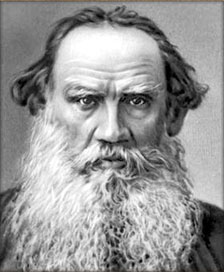
Tolstoy Lev Nikolaevich
(1828—1910s)