War and Peace
sent a manservant to the Vozdvizhenka to ascertain whether he had come. He had not arrived. She suffered more now than during her first days in Moscow. To her impatience and pining for him were now added the unpleasant recollection of her interview with Princess Mary and the old prince, and a fear and anxiety of which she did not understand the cause. She continually fancied that either he would never come or that something would happen to her before he came. She could no longer think of him by herself calmly and continuously as she had done before. As soon as she began to think of him, the recollection of the old prince, of Princess Mary, of the theater, and of Kuragin mingled with her thoughts. The question again presented itself whether she was not guilty, whether she had not already broken faith with Prince Andrew, and again she found herself recalling to the minutest detail every word, every gesture, and every shade in the play of expression on the face of the man who had been able to arouse in her such an incomprehensible and terrifying feeling. To the family Natasha seemed livelier than usual, but she was far less tranquil and happy than before.On Sunday morning Marya Dmitrievna invited her visitors to Mass at her parish church—the Church of the Assumption built over the graves of victims of the plague.
“I don’t like those fashionable churches,” she said, evidently priding herself on her independence of thought. “God is the same everywhere. We have an excellent priest, he conducts the service decently and with dignity, and the deacon is the same. What holiness is there in giving concerts in the choir? I don’t like it, it’s just self-indulgence!”
Marya Dmitrievna liked Sundays and knew how to keep them. Her whole house was scrubbed and cleaned on Saturdays; neither she nor the servants worked, and they all wore holiday dress and went to church. At her table there were extra dishes at dinner, and the servants had vodka and roast goose or suckling pig. But in nothing in the house was the holiday so noticeable as in Marya Dmitrievna’s broad, stern face, which on that day wore an invariable look of solemn festivity.
After Mass, when they had finished their coffee in the dining room where the loose covers had been removed from the furniture, a servant announced that the carriage was ready, and Marya Dmitrievna rose with a stern air. She wore her holiday shawl, in which she paid calls, and announced that she was going to see Prince Nicholas Bolkonski to have an explanation with him about Natasha.
After she had gone, a dressmaker from Madame Suppert-Roguet waited on the Rostovs, and Natasha, very glad of this diversion, having shut herself into a room adjoining the drawing room, occupied herself trying on the new dresses. Just as she had put on a bodice without sleeves and only tacked together, and was turning her head to see in the glass how the back fitted, she heard in the drawing room the animated sounds of her father’s voice and another’s—a woman’s—that made her flush. It was Helene. Natasha had not time to take off the bodice before the door opened and Countess Bezukhova, dressed in a purple velvet gown with a high collar, came into the room beaming with good-humored amiable smiles.
“Oh, my enchantress!” she cried to the blushing Natasha. “Charming! No, this is really beyond anything, my dear count,” said she to Count Rostov who had followed her in. “How can you live in Moscow and go nowhere? No, I won’t let you off! Mademoiselle George will recite at my house tonight and there’ll be some people, and if you don’t bring your lovely girls—who are prettier than Mademoiselle George—I won’t know you! My husband is away in Tver 1 or I would send him to fetch you. You must come. You positively must! Between eight and nine.”
She nodded to the dressmaker, whom she knew and who had curtsied respectfully to her, and seated herself in an armchair beside the looking glass, draping the folds of her velvet dress picturesquely. She did not cease chattering good-naturedly and gaily, continually praising Natasha’s beauty. She looked at Natasha’s dresses and praised them, as well as a new dress of her own made of “metallic gauze,” which she had received from Paris, and advised Natasha to have one like it.
“But anything suits you, my charmer!” she remarked.
A smile of pleasure never left Natasha’s face. She felt happy and as if she were blossoming under the praise of this dear Countess Bezukhova who had formerly seemed to her so unapproachable and important and was now so kind to her. Natasha brightened up and felt almost in love with this woman, who was so beautiful and so kind. Helene for her part was sincerely delighted with Natasha and wished to give her a good time. Anatole had asked her to bring him and Natasha together, and she was calling on the Rostovs for that purpose. The idea of throwing her brother and Natasha together amused her.
Though at one time, in Petersburg, she had been annoyed with Natasha for drawing Boris away, she did not think of that now, and in her own way heartily wished Natasha well. As she was leaving the Rostovs she called her protegee aside.
“My brother dined with me yesterday—we nearly died of laughter—he ate nothing and kept sighing for you, my charmer! He is madly, quite madly, in love with you, my dear.”
Natasha blushed scarlet when she heard this.
“How she blushes, how she blushes, my pretty!” said Helene. “You must certainly come. If you love somebody, my charmer, that is not a reason to shut yourself up. Even if you are engaged, I am sure your fiance would wish you to go into society rather than be bored to death.”
“So she knows I am engaged, and she and her husband Pierre—that good Pierre—have talked and laughed about this. So it’s all right.” And again, under Helene’s influence, what had seemed terrible now seemed simple and natural. “And she is such a grande dame, so kind, and evidently likes me so much. And why not enjoy myself?” thought Natasha, gazing at Helene with wide-open, wondering eyes.
Marya Dmitrievna came back to dinner taciturn and serious, having evidently suffered a defeat at the old prince’s. She was still too agitated by the encounter to be able to talk of the affair calmly. In answer to the count’s inquiries she replied that things were all right and that she would tell about it next day. On hearing of Countess Bezukhova’s visit and the invitation for that evening, Marya Dmitrievna remarked:
“I don’t care to have anything to do with Bezukhova and don’t advise you to; however, if you’ve promised—go. It will divert your thoughts,” she added, addressing Natasha.
COUNT ROSTOV took the girls to Countess Bezukhova’s. There were a good many people there, but nearly all strangers to Natasha. Count Rostov was displeased to see that the company consisted almost entirely of men and women known for the freedom of their conduct. Mademoiselle George was standing in a corner of the drawing room surrounded by young men. There were several Frenchmen present, among them Metivier who from the time Helene reached Moscow had been an intimate in her house. The count decided not to sit down to cards or let his girls out of his sight and to get away as soon as Mademoiselle George’s performance was over.
Anatole was at the door, evidently on the lookout for the Rostovs. Immediately after greeting the count he went up to Natasha and followed her. As soon as she saw him she was seized by the same feeling she had had at the opera—gratified vanity at his admiration of her and fear at the absence of a moral barrier between them.
Helene welcomed Natasha delightedly and was loud in admiration of her beauty and her dress. Soon after their arrival Mademoiselle George went out of the room to change her costume. In the drawing room people began arranging the chairs and taking their seats. Anatole moved a chair for Natasha and was about to sit down beside her, but the count, who never lost sight of her, took the seat himself. Anatole sat down behind her.
Mademoiselle George, with her bare, fat, dimpled arms, and a red shawl draped over one shoulder, came into the space left vacant for her, and assumed an unnatural pose. Enthusiastic whispering was audible.
Mademoiselle George looked sternly and gloomily at the audience and began reciting some French verses describing her guilty love for her son. In some places she raised her voice, in others she whispered, lifting her head triumphantly; sometimes she paused and uttered hoarse sounds, rolling her eyes.
“Adorable! divine! delicious!” was heard from every side.
Natasha looked at the fat actress, but neither saw nor heard nor understood anything of what went on before her. She only felt herself again completely borne away into this strange senseless world—so remote from her old world—a world in which it was impossible to know what was good or bad, reasonable or senseless. Behind her sat Anatole, and conscious of his proximity she experienced a frightened sense of expectancy.
After the first monologue the whole company rose and surrounded Mademoiselle George, expressing their enthusiasm.
“How beautiful she is!” Natasha remarked to her father who had also risen
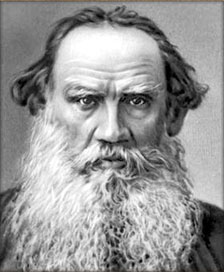
Tolstoy Lev Nikolaevich
(1828—1910s)