War and Peace
over between me and Bolkonski. Why do you think so badly of me?”“I don’t think anything, only I don’t understand this . . .”
“Wait a bit, Sonya, you’ll understand everything. You’ll see what a man he is! Now don’t think badly of me or of him. I don’t think badly of anyone: I love and pity everybody. But what am I to do?”
Sonya did not succumb to the tender tone Natasha used toward her. The more emotional and ingratiating the expression of Natasha’s face became, the more serious and stern grew Sonya’s.
“Natasha,” said she, “you asked me not to speak to you, and I haven’t spoken, but now you yourself have begun. I don’t trust him, Natasha. Why this secrecy?”
“Again, again!” interrupted Natasha.
“Natasha, I am afraid for you!”
“Afraid of what?”
“I am afraid you’re going to your ruin,” said Sonya resolutely, and was herself horrified at what she had said.
Anger again showed in Natasha’s face.
“And I’ll go to my ruin, I will, as soon as possible! It’s not your business! It won’t be you, but I, who’ll suffer. Leave me alone, leave me alone! I hate you!”
“Natasha!” moaned Sonya, aghast.
“I hate you, I hate you! You’re my enemy forever!” And Natasha ran out of the room.
Natasha did not speak to Sonya again and avoided her. With the same expression of agitated surprise and guilt she went about the house, taking up now one occupation, now another, and at once abandoning them.
Hard as it was for Sonya, she watched her friend and did not let her out of her sight.
The day before the count was to return, Sonya noticed that Natasha sat by the drawing-room window all the morning as if expecting something and that she made a sign to an officer who drove past, whom Sonya took to be Anatole.
Sonya began watching her friend still more attentively and noticed that at dinner and all that evening Natasha was in a strange and unnatural state. She answered questions at random, began sentences she did not finish, and laughed at everything.
After tea Sonya noticed a housemaid at Natasha’s door timidly waiting to let her pass. She let the girl go in, and then listening at the door learned that another letter had been delivered.
Then suddenly it became clear to Sonya that Natasha had some dreadful plan for that evening. Sonya knocked at her door. Natasha did not let her in.
“She will run away with him!” thought Sonya. “She is capable of anything. There was something particularly pathetic and resolute in her face today. She cried as she said good-by to Uncle,” Sonya remembered. “Yes, that’s it, she means to elope with him, but what am I to do?” thought she, recalling all the signs that clearly indicated that Natasha had some terrible intention. “The count is away. What am I to do? Write to Kuragin demanding an explanation? But what is there to oblige him to reply? Write to Pierre, as Prince Andrew asked me to in case of some misfortune? . . . But perhaps she really has already refused Bolkonski—she sent a letter to Princess Mary yesterday. And Uncle is away. . . .” To tell Marya Dmitrievna who had such faith in Natasha seemed to Sonya terrible. “Well, anyway,” thought Sonya as she stood in the dark passage, “now or never I must prove that I remember the family’s goodness to me and that I love Nicholas. Yes! If I don’t sleep for three nights I’ll not leave this passage and will hold her back by force and will and not let the family be disgraced,” thought she.
- Anatole at Dólokhov’s. Balagá
ANATOLE had lately moved to Dolokhov’s. The plan for Natalie Rostova’s abduction had been arranged and the preparations made by Dolokhov a few days before, and on the day that Sonya, after listening at Natasha’s door, resolved to safeguard her, it was to have been put into execution. Natasha had promised to come out to Kuragin at the back porch at ten that evening. Kuragin was to put her into a troyka he would have ready and to drive her forty miles to the village of Kamenka, where an unfrocked priest was in readiness to perform a marriage ceremony over them. At Kamenka a relay of horses was to wait which would take them to the Warsaw highroad, and from there they would hasten abroad with post horses.
Anatole had a passport, an order for post horses, ten thousand rubles he had taken from his sister and another ten thousand borrowed with Dolokhov’s help.
Two witnesses for the mock marriage—Khvostikov, a retired petty official whom Dolokhov made use of in his gambling transactions, and Makarin, a retired hussar, a kindly, weak fellow who had an unbounded affection for Kuragin—were sitting at tea in Dolokhov’s front room.
In his large study, the walls of which were hung to the ceiling with Persian rugs, bearskins, and weapons, sat Dolokhov in a traveling cloak and high boots, at an open desk on which lay an abacus and some bundles of paper money. Anatole, with uniform unbuttoned, walked to and fro from the room where the witnesses were sitting, through the study to the room behind, where his French valet and others were packing the last of his things. Dolokhov was counting the money and noting something down.
“Well,” he said, “Khvostikov must have two thousand.”
“Give it to him, then,” said Anatole.
“Makarka” (their name for Makarin) “will go through fire and water for you for nothing. So here are our accounts all settled,” said Dolokhov, showing him the memorandum. “Is that right?”
“Yes, of course,” returned Anatole, evidently not listening to Dolokhov and looking straight before him with a smile that did not leave his face.
Dolokhov banged down the lid of his desk and turned to Anatole with an ironic smile:
“Do you know? You’d really better drop it all. There’s still time!”
“Fool,” retorted Anatole. “Don’t talk nonsense! If you only knew . . . it’s the devil knows what!”
“No, really, give it up!” said Dolokhov. “I am speaking seriously. It’s no joke, this plot you’ve hatched.”
“What, teasing again? Go to the devil! Eh?” said Anatole, making a grimace. “Really it’s no time for your stupid jokes,” and he left the room.
Dolokhov smiled contemptuously and condescendingly when Anatole had gone out.
“You wait a bit,” he called after him. “I’m not joking, I’m talking sense. Come here, come here!”
Anatole returned and looked at Dolokhov, trying to give him his attention and evidently submitting to him involuntarily.
“Now listen to me. I’m telling you this for the last time. Why should I joke about it? Did I hinder you? Who arranged everything for you? Who found the priest and got the passport? Who raised the money? I did it all.”
“Well, thank you for it. Do you think I am not grateful?” And Anatole sighed and embraced Dolokhov.
“I helped you, but all the same I must tell you the truth; it is a dangerous business, and if you think about it—a stupid business. Well, you’ll carry her off—all right! Will they let it stop at that? It will come out that you’re already married. Why, they’ll have you in the criminal court. . . .”
“Oh, nonsense, nonsense!” Anatole ejaculated and again made a grimace. “Didn’t I explain to you? What?” And Anatole, with the partiality dull-witted people have for any conclusion they have reached by their own reasoning, repeated the argument he had already put to Dolokhov a hundred times. “Didn’t I explain to you that I have come to this conclusion: if this marriage is invalid,” he went on, crooking one finger, “then I have nothing to answer for; but if it is valid, no matter! Abroad no one will know anything about it. Isn’t that so? And don’t talk to me, don’t, don’t.”
“Seriously, you’d better drop it! You’ll only get yourself into a mess!”
“Go to the devil!” cried Anatole and, clutching his hair, left the room, but returned at once and dropped into an armchair in front of Dolokhov with his feet turned under him. “It’s the very devil! What? Feel how it beats!” He took Dolokhov’s hand and put it on his heart. “What a foot, my dear fellow! What a glance! A goddess!” he added in French. “What?”
Dolokhov with a cold smile and a gleam in his handsome insolent eyes looked at him—evidently wishing to get some more amusement out of him.
“Well and when the money’s gone, what then?”
“What then? Eh?” repeated Anatole, sincerely perplexed by a thought of the future. “What then? . . . Then, I don’t know. . . . But why talk nonsense!” He glanced at his watch. “It’s time!”
Anatole went into the back room.
“Now then! Nearly ready? You’re dawdling!” he shouted to the servants.
Dolokhov put away the money, called a footman whom he ordered to bring something for them to eat and drink before the journey, and went into the room where Khvostikov and Makarin were sitting.
Anatole lay on the sofa in the study leaning on his elbow and smiling pensively, while his handsome lips muttered tenderly to himself.
“Come and eat something. Have a drink!” Dolokhov shouted to him from the other room.
“I don’t want to,” answered Anatole continuing to smile.
“Come! Balaga is here.”
Anatole rose and went into the dining room. Balaga was a famous troyka driver who had known Dolokhov and Anatole some six years and had given them good service with his troykas. More than once when Anatole’s regiment was stationed at Tver he had taken him from Tver in the evening, brought him to Moscow by daybreak, and driven him back again the next night. More than once he had
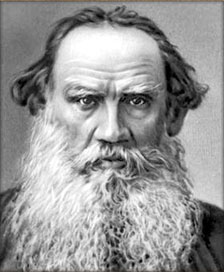
Tolstoy Lev Nikolaevich
(1828—1910s)