War and Peace
enabled Dolokhov to escape when pursued. More than once he had driven them through the town with gypsies and “ladykins” as he called the cocottes. More than once in their service he had run over pedestrians and upset vehicles in the streets of Moscow and had always been protected from the consequences by “my gentlemen” as he called them. He had ruined more than one horse in their service. More than once they had beaten him, and more than once they had made him drunk on champagne and Madeira, which he loved; and he knew more than one thing about each of them which would long ago have sent an ordinary man to Siberia. They often called Balaga into their orgies and made him drink and dance at the gypsies’, and more than one thousand rubles of their money had passed through his hands. In their service he risked his skin and his life twenty times a year, and in their service had lost more horses than the money he had from them would buy. But he liked them; liked that mad driving at twelve miles an hour, liked upsetting a driver or running down a pedestrian, and flying at full gallop through the Moscow streets. He liked to hear those wild, tipsy shouts behind him: “Get on! Get on!” when it was impossible to go any faster. He liked giving a painful lash on the neck to some peasant who, more dead than alive, was already hurrying out of his way. “Real gentlemen!” he considered them.Anatole and Dolokhov liked Balaga too for his masterly driving and because he liked the things they liked. With others Balaga bargained, charging twenty-five rubles for a two hours’ drive, and rarely drove himself, generally letting his young men do so. But with “his gentlemen” he always drove himself and never demanded anything for his work. Only a couple of times a year—when he knew from their valets that they had money in hand—he would turn up of a morning quite sober and with a deep bow would ask them to help him. The gentlemen always made him sit down.
“Do help me out, Theodore Ivanych, sir,” or “your excellency,” he would say. “I am quite out of horses. Let me have what you can to go to the fair.”
And Anatole and Dolokhov, when they had money, would give him a thousand or a couple of thousand rubles.
Balaga was a fair-haired, short, and snub-nosed peasant of about twenty-seven; red-faced, with a particularly red thick neck, glittering little eyes, and a small beard. He wore a fine, dark-blue, silk-lined cloth coat over a sheepskin.
On entering the room now he crossed himself, turning toward the front corner of the room, and went up to Dolokhov, holding out a small, black hand.
“Theodore Ivanych!” he said, bowing.
“How d’you do, friend? Well, here he is!”
“Good day, your excellency!” he said, again holding out his hand to Anatole who had just come in.
“I say, Balaga,” said Anatole, putting his hands on the man’s shoulders, “do you care for me or not? Eh? Now, do me a service. . . . What horses have you come with? Eh?”
“As your messenger ordered, your special beasts,” replied Balaga.
“Well, listen, Balaga! Drive all three to death but get me there in three hours. Eh?”
“When they are dead, what shall I drive?” said Balaga with a wink.
“Mind, I’ll smash your face in! Don’t make jokes!” cried Anatole, suddenly rolling his eyes.
“Why joke?” said the driver, laughing. “As if I’d grudge my gentlemen anything! As fast as ever the horses can gallop, so fast we’ll go!”
“Ah!” said Anatole. “Well, sit down.”
“Yes, sit down!” said Dolokhov.
“I’ll stand, Theodore Ivanych.”
“Sit down; nonsense! Have a drink!” said Anatole, and filled a large glass of Madeira for him.
The driver’s eyes sparkled at the sight of the wine. After refusing it for manners’ sake, he drank it and wiped his mouth with a red silk handkerchief he took out of his cap.
“And when are we to start, your excellency?”
“Well . . .” Anatole looked at his watch. “We’ll start at once. Mind, Balaga! You’ll get there in time? Eh?”
“That depends on our luck in starting, else why shouldn’t we be there in time?” replied Balaga. “Didn’t we get you to Tver in seven hours? I think you remember that, your excellency?”
“Do you know, one Christmas I drove from Tver,” said Anatole, smilingly at the recollection and turning to Makarin who gazed rapturously at him with wide-open eyes. “Will you believe it, Makarka, it took one’s breath away, the rate we flew. We came across a train of loaded sleighs and drove right over two of them. Eh?”
“Those were horses!” Balaga continued the tale. “That time I’d harnessed two young side horses with the bay in the shafts,” he went on, turning to Dolokhov. “Will you believe it, Theodore Ivanych, those animals flew forty miles? I couldn’t hold them in, my hands grew numb in the sharp frost so that I threw down the reins—‘Catch hold yourself, your excellency!’ says I, and I just tumbled on the bottom of the sleigh and sprawled there. It wasn’t a case of urging them on, there was no holding them in till we reached the place. The devils took us there in three hours! Only the near one died of it.”
ANATATOLE went out of the room and returned a few minutes later wearing a fur coat girt with a silver belt, and a sable cap jauntily set on one side and very becoming to his handsome face. Having looked in a mirror, and standing before Dolokhov in the same pose he had assumed before it, he lifted a glass of wine.
“Well, good-by, Theodore. Thank you for everything and farewell!” said Anatole. “Well, comrades and friends . . .” he considered for a moment “ . . . of my youth, farewell!” he said, turning to Makarin and the others.
Though they were all going with him, Anatole evidently wished to make something touching and solemn out of this address to his comrades. He spoke slowly in a loud voice and throwing out his chest slightly swayed one leg.
“All take glasses; you too, Balaga. Well, comrades and friends of my youth, we’ve had our fling and lived and reveled. Eh? And now, when shall we meet again? I am going abroad. We have had a good time—now farewell, lads! To our health! Hurrah! . . .” he cried, and emptying his glass flung it on the floor.
“To your health!” said Balaga who also emptied his glass, and wiped his mouth with his handkerchief.
Makarin embraced Anatole with tears in his eyes.
“Ah, Prince, how sorry I am to part from you!
“Let’s go. Let’s go!” cried Anatole.
Balaga was about to leave the room.
“No, stop!” said Anatole. “Shut the door; we have first to sit down. That’s the way.”
They shut the door and all sat down.1
“Now, quick march, lads!” said Anatole, rising.
Joseph, his valet, handed him his sabretache and saber, and they all went out into the vestibule.
“And where’s the fur cloak?” asked Dolokhov. “Hey, Ignatka! Go to Matrena Matrevna and ask her for the sable cloak. I have heard what elopements are like,” continued Dolokhov with a wink. “Why, she’ll rush out more dead than alive just in the things she is wearing; if you delay at all there’ll be tears and ‘Papa’ and ‘Mamma,’ and she’s frozen in a minute and must go back—but you wrap the fur cloak round her first thing and carry her to the sleigh.”
The valet brought a woman’s fox-lined cloak.
“Fool, I told you the sable one! Hey, Matrena, the sable!” he shouted so that his voice rang far through the rooms.
A handsome, slim, and pale-faced gypsy girl with glittering black eyes and curly blue-black hair, wearing a red shawl, ran out with a sable mantle on her arm.
“Here, I don’t grudge it—take it!” she said, evidently afraid of her master and yet regretful of her cloak.
Dolokhov, without answering, took the cloak, threw it over Matrena, and wrapped her up in it.
“That’s the way,” said Dolokhov, “and then so!” and he turned the collar up round her head, leaving only a little of the face uncovered. “And then so, do you see?” and he pushed Anatole’s head forward to meet the gap left by the collar, through which Matrena’s brilliant smile was seen.
“Well, good-by, Matrena,” said Anatole, kissing her. “Ah, my revels here are over. Remember me to Steshka. There, good-by! Good-bye, Matrena, wish me luck!”
“Well, Prince, may God give you great luck!” said Matrena in her gypsy accent.
Two troykas were standing before the porch and two young drivers were holding the horses. Balaga took his seat in the front one and holding his elbows high arranged the reins deliberately. Anatole and Dolokhov got in with him. Makarin, Khvostikov, and a valet seated themselves in the other sleigh.
“Well, are you ready?” asked Balaga.
“Go!” he cried, twisting the reins round his hands, and the troyka tore down the Nikitski Boulevard.
“Tproo! Get out of the way! Hi! . . . Tproo! . . .” The shouting of Balaga and of the sturdy young fellow seated on the box was all that could be heard. On the Arbat Square the troyka caught against a carriage; something cracked, shouts were heard, and the troyka flew along the Arbat Street.
After taking a turn along the Podnovinski Boulevard, Balaga began to rein in, and turning back drew up at the crossing of the old Konyusheny Street.
The young fellow on the box jumped down to hold the horses and Anatole and Dolokhov went
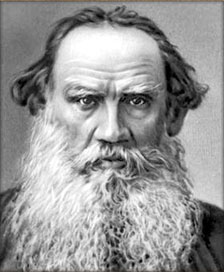
Tolstoy Lev Nikolaevich
(1828—1910s)