War and Peace
his soul in connection with that tree. During this journey he, as it were, considered his life afresh and arrived at his old conclusion, restful in its hopelessness: that it was not for him to begin anything anew—but that he must live out his life, content to do no harm, and not disturbing himself or desiring anything.PRINCE ANDREW had to see the Marshal of the Nobility for the district in connection with the affairs of the Ryazan estate of which he was trustee. This Marshal was Count Ilya Rostov, and in the middle of May Prince Andrew went to visit him.
It was now hot spring weather. The whole forest was already clothed in green. It was dusty and so hot that on passing near water one longed to bathe.
Prince Andrew, depressed and preoccupied with the business about which he had to speak to the Marshal, was driving up the avenue in the grounds of the Rostovs’ house at Otradnoe. He heard merry girlish cries behind some trees on the right and saw a group of girls running to cross the path of his caleche. Ahead of the rest and nearer to him ran a dark-haired, remarkably slim, pretty girl in a yellow chintz dress, with a white handkerchief on her head from under which loose locks of hair escaped. The girl was shouting something but, seeing that he was a stranger, ran back laughing without looking at him.
Suddenly, he did not know why, he felt a pang. The day was so beautiful, the sun so bright, everything around so gay, but that slim pretty girl did not know, or wish to know, of his existence and was contented and cheerful in her own separate—probably foolish—but bright and happy life. “What is she so glad about? What is she thinking of? Not of the military regulations or of the arrangement of the Ryazan serfs’ quitrents. Of what is she thinking? Why is she so happy?” Prince Andrew asked himself with instinctive curiosity.
In 1809 Count Ilya Rostov was living at Otradnoe just as he had done in former years, that is, entertaining almost the whole province with hunts, theatricals, dinners, and music. He was glad to see Prince Andrew, as he was to see any new visitor, and insisted on his staying the night.
During the dull day, in the course of which he was entertained by his elderly hosts and by the more important of the visitors (the old count’s house was crowded on account of an approaching name day), Prince Andrew repeatedly glanced at Natasha, gay and laughing among the younger members of the company, and asked himself each time, “What is she thinking about? Why is she so glad?”
That night, alone in new surroundings, he was long unable to sleep. He read awhile and then put out his candle, but relit it. It was hot in the room, the inside shutters of which were closed. He was cross with the stupid old man (as he called Rostov), who had made him stay by assuring him that some necessary documents had not yet arrived from town, and he was vexed with himself for having stayed.
He got up and went to the window to open it. As soon as he opened the shutters the moonlight, as if it had long been watching for this, burst into the room. He opened the casement. The night was fresh, bright, and very still. Just before the window was a row of pollard trees, looking black on one side and with a silvery light on the other. Beneath the trees grew some kind of lush, wet, bushy vegetation with silver-lit leaves and stems here and there. Farther back beyond the dark trees a roof glittered with dew, to the right was a leafy tree with brilliantly white trunk and branches, and above it shone the moon, nearly at its full, in a pale, almost starless, spring sky. Prince Andrew leaned his elbows on the window ledge and his eyes rested on that sky.
His room was on the first floor. Those in the rooms above were also awake. He heard female voices overhead.
“Just once more,” said a girlish voice above him which Prince Andrew recognized at once.
“But when are you coming to bed?” replied another voice.
“I won’t, I can’t sleep, what’s the use? Come now for the last time.”
Two girlish voices sang a musical passage—the end of some song.
“Oh, how lovely! Now go to sleep, and there’s an end of it.”
“You go to sleep, but I can’t,” said the first voice, coming nearer to the window. She was evidently leaning right out, for the rustle of her dress and even her breathing could be heard. Everything was stone-still, like the moon and its light and the shadows. Prince Andrew, too, dared not stir, for fear of betraying his unintentional presence.
“Sonya! Sonya!” he again heard the first speaker. “Oh, how can you sleep? Only look how glorious it is! Ah, how glorious! Do wake up, Sonya!” she said almost with tears in her voice. “There never, never was such a lovely night before!”
Sonya made some reluctant reply.
“Do just come and see what a moon! . . . Oh, how lovely! Come here. . . . Darling, sweetheart, come here! There, you see? I feel like sitting down on my heels, putting my arms round my knees like this, straining tight, as tight as possible, and flying away! Like this. . . .”1
“Take care, you’ll fall out.”
He heard the sound of a scuffle and Sonya’s disapproving voice: “It’s past one o’clock.”
“Oh, you only spoil things for me. All right, go, go!”
Again all was silent, but Prince Andrew knew she was still sitting there. From time to time he heard a soft rustle and at times a sigh.
“O God, O God! What does it mean?” she suddenly exclaimed. “To bed then, if it must be!” and she slammed the casement.
“For her I might as well not exist!” thought Prince Andrew while he listened to her voice, for some reason expecting yet fearing that she might say something about him. “There she is again! As if it were on purpose,” thought he.
In his soul there suddenly arose such an unexpected turmoil of youthful thoughts and hopes, contrary to the whole tenor of his life, that unable to explain his condition to himself he lay down and fell asleep at once.
NEXT MORNING, having taken leave of no one but the count, and not waiting for the ladies to appear, Prince Andrew set off for home.
It was already the beginning of June when on his return journey he drove into the birch forest where the gnarled old oak had made so strange and memorable an impression on him. In the forest the harness bells sounded yet more muffled than they had done six weeks before, for now all was thick, shady, and dense, and the young firs dotted about in the forest did not jar on the general beauty but, lending themselves to the mood around, were delicately green with fluffy young shoots.
The whole day had been hot. Somewhere a storm was gathering, but only a small cloud had scattered some raindrops lightly, sprinkling the road and the sappy leaves. The left side of the forest was dark in the shade, the right side glittered in the sunlight, wet and shiny and scarcely swayed by the breeze. Everything was in blossom, the nightingales trilled, and their voices reverberated now near, now far away.
“Yes, here in this forest was that oak with which I agreed,” thought Prince Andrew. “But where is it?” he again wondered, gazing at the left side of the road, and without recognizing it he looked with admiration at the very oak he sought. The old oak, quite transfigured, spreading out a canopy of sappy dark-green foliage, stood rapt and slightly trembling in the rays of the evening sun. Neither gnarled fingers nor old scars nor old doubts and sorrows were any of them in evidence now. Through the hard century-old bark, even where there were no twigs, leaves had sprouted such as one could hardly believe the old veteran could have produced.
“Yes, it is the same oak,” thought Prince Andrew, and all at once he was seized by an unreasoning springtime feeling of joy and renewal. All the best moments of his life suddenly rose to his memory. Austerlitz with the lofty heavens, his wife’s dead reproachful face, Pierre at the ferry, that girl thrilled by the beauty of the night, and that night itself and the moon, and. . . . all this rushed suddenly to his mind.
“No, life is not over at thirty-one!” Prince Andrew suddenly decided finally and decisively. “It is not enough for me to know what I have in me—everyone must know it: Pierre, and that young girl who wanted to fly away into the sky, everyone must know me, so that my life may not be lived for myself alone while others live so apart from it, but so that it may be reflected in them all, and they and I may live in harmony!”
On reaching home Prince Andrew decided to go to Petersburg that autumn and found all sorts of reasons for this decision. A whole series of sensible and logical considerations showing it to be essential for him to go to Petersburg, and even to re-enter the service, kept springing up in his mind. He could not now understand how he could ever even have doubted the necessity of taking an active share in life, just as a month before he had not understood how the idea of leaving the quiet country
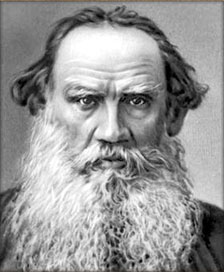
Tolstoy Lev Nikolaevich
(1828—1910s)