War and Peace
after the delivery of his speech at the lodge he lay on a sofa at home receiving no one and going nowhere.3It was just then that he received a letter from his wife, who implored him to see her, telling him how grieved she was about him and how she wished to devote her whole life to him.
At the end of the letter she informed him that in a few days she would return to Petersburg from abroad.
Following this letter one of the masonic Brothers whom Pierre respected less than the others forced his way in to see him and, turning the conversation upon Pierre’s matrimonial affairs, by way of fraternal advice expressed the opinion that his severity to his wife was wrong and that he was neglecting one of the first rules of Freemasonry by not forgiving the penitent.
At the same time his mother-in-law, Prince Vasili’s wife, sent to him imploring him to come if only for a few minutes to discuss a most important matter. Pierre saw that there was a conspiracy against him and that they wanted to reunite him with his wife, and in the mood he then was, this was not even unpleasant to him. Nothing mattered to him. Nothing in life seemed to him of much importance, and under the influence of the depression that possessed him he valued neither his liberty nor his resolution to punish his wife.
“No one is right and no one is to blame; so she too is not to blame,” he thought.
If he did not at once give his consent to a reunion with his wife, it was only because in his state of depression he did not feel able to take any step. Had his wife come to him, he would not have turned her away. Compared to what preoccupied him, was it not a matter of indifference whether he lived with his wife or not?
Without replying either to his wife or his mother-in-law, Pierre late one night prepared for a journey and started for Moscow to see Joseph Alexeevich. This is what he noted in his diary:
Moscow, 17th November
I have just returned from my benefactor, and hasten to write down what I have experienced. Joseph Alexeevich is living poorly and has for three years been suffering from a painful disease of the bladder. No one has ever heard him utter a groan or a word of complaint. From morning till late at night, except when he eats his very plain food, he is working at science. He received me graciously and made me sit down on the bed on which he lay. I made the sign of the Knights of the East and of Jerusalem, and he responded in the same manner, asking me with a mild smile what I had learned and gained in the Prussian and Scottish lodges.4 I told him everything as best I could, and told him what I had proposed to our Petersburg lodge, of the bad reception I had encountered, and of my rupture with the Brothers. Joseph Alexeevich, having remained silent and thoughtful for a good while, told me his view of the matter, which at once lit up for me my whole past and the future path I should follow. He surprised me by asking whether I remembered the threefold aim of the order: (1) The preservation and study of the mystery. (2) The purification and reformation of oneself for its reception, and (3) The improvement of the human race by striving for such purification. Which is the principal aim of these three? Certainly self-reformation and self-purification. Only to this aim can we always strive independently of circumstances. But at the same time just this aim demands the greatest efforts of us; and so, led astray by pride, losing sight of this aim, we occupy ourselves either with the mystery which in our impurity we are unworthy to receive, or seek the reformation of the human race while ourselves setting an example of baseness and profligacy. Illuminism is not a pure doctrine, just because it is attracted by social activity and puffed up by pride. On this ground Joseph Alexeevich condemned my speech and my whole activity, and in the depth of my soul I agreed with him. Talking of my family affairs he said to me, “the chief duty of a true Mason, as I have told you, lies in perfecting himself. We often think that by removing all the difficulties of our life we shall more quickly reach our aim, but on the contrary, my dear sir, it is only in the midst of worldly cares that we can attain our three chief aims: (1) Self-knowledge—for man can only know himself by comparison, (2) Self-perfecting, which can only be attained by conflict, and (3) The attainment of the chief virtue—love of death. Only the vicissitudes of life can show us its vanity and develop our innate love of death or of rebirth to a new life.” These words are all the more remarkable because, in spite of his great physical sufferings, Joseph Alexeevich is never weary of life though he loves death, for which—in spite of the purity and loftiness of his inner man—he does not yet feel himself sufficiently prepared. My benefactor then explained to me fully the meaning of the Great Square of creation and pointed out to me that the numbers three and seven are the basis of everything. He advised me not to avoid intercourse with the Petersburg Brothers, but to take up only second-grade posts in the lodge, to try, while diverting the Brothers from pride, to turn them toward the true path self-knowledge and self-perfecting. Besides this he advised me for myself personally above all to keep a watch over myself, and to that end he gave me a notebook, the one I am now writing in and in which I will in future note down all my actions.
Petersburg, 23rd November
I am again living with my wife. My mother-in-law came to me in tears and said that Helene was here and that she implored me to hear her; that she was innocent and unhappy at my desertion, and much more. I knew that if I once let myself see her I should not have strength to go on refusing what she wanted. In my perplexity I did not know whose aid and advice to seek. Had my benefactor been here he would have told me what to do. I went to my room and reread Joseph Alexeevich’s letters and recalled my conversations with him, and deduced from it all that I ought not to refuse a supplicant, and ought to reach a helping hand to everyone—especially to one so closely bound to me—and that I must bear my cross. But if I forgive her for the sake of doing right, then let union with her have only a spiritual aim. That is what I decided, and what I wrote to Joseph Alexeevich. I told my wife that I begged her to forget the past, to forgive me whatever wrong I may have done her, and that I had nothing to forgive. It gave me joy to tell her this. She need not know how hard it was for me to see her again. I have settled on the upper floor of this big house and am experiencing a happy feeling of regeneration.
AT THAT TIME, as always happens, the highest society that met at court and at the grand balls was divided into several circles, each with its own particular tone. The largest of these was the French circle of the Napoleonic alliance, the circle of Count Rumyantsev and Caulaincourt.1 In this group Helene, as soon as she had settled in Petersburg with her husband, took a very prominent place. She was visited by the members of the French embassy and by many belonging to that circle and noted for their intellect and polished manners.
Helene had been at Erfurt during the famous meeting of the Emperors and had brought from there these connections with the Napoleonic notabilities.2 At Erfurt her success had been brilliant. Napoleon himself had noticed her in the theater and said of her: “C’est un superbe animal [That’s a
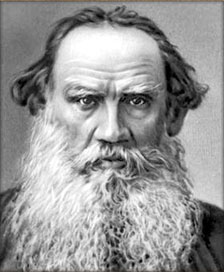
Tolstoy Lev Nikolaevich
(1828—1910s)