War and Peace
. . .” (she grew confused) “is agreeable to us, and I accept your offer. I am glad. And my husband . . . I hope . . . but it will depend on her. . . .”“I will speak to her when I have your consent. . . . Do you give it to me?” said Prince Andrew.
“Yes,” replied the countess. She held out her hand to him, and with a mixed feeling of estrangement and tenderness pressed her lips to his forehead as he stooped to kiss her hand. She wished to love him as a son, but felt that to her he was a stranger and a terrifying man. “I am sure my husband will consent,” said the countess, “but your father . . .”
“My father, to whom I have told my plans, has made it an express condition of his consent that the wedding is not to take place for a year. And I wished to tell you of that,” said Prince Andrew.
“It is true that Natasha is still young, but—so long as that? . . .”
“It is unavoidable,” said Prince Andrew with a sigh.
“I will send her to you,” said the countess, and left the room.
“Lord have mercy upon us!” she repeated while seeking her daughter.
Sonya said that Natasha was in her bedroom. Natasha was sitting on the bed, pale and dry eyed, and was gazing at the icons and whispering something as she rapidly crossed herself. Seeing her mother she jumped up and flew to her.
“Well, Mamma? . . . Well? . . .”
“Go, go to him. He is asking for your hand,” said the countess, coldly it seemed to Natasha. “Go . . . go,” said the mother, sadly and reproachfully, with a deep sigh, as her daughter ran away.
Natasha never remembered how she entered the drawing room. When she came in and saw him she paused. “Is it possible that this stranger has now become everything to me?” she asked herself, and immediately answered, “Yes, everything! He alone is now dearer to me than everything in the world.” Prince Andrew came up to her with downcast eyes.
“I have loved you from the very first moment I saw you. May I hope?”
He looked at her and was struck by the serious impassioned expression of her face. Her face said: “Why ask? Why doubt what you cannot but know? Why speak, when words cannot express what one feels?”
She drew near to him and stopped. He took her hand and kissed it.
“Do you love me?”
“Yes, yes!” Natasha murmured as if in vexation. Then she sighed loudly and, catching her breath more and more quickly, began to sob.
“What is it? What’s the matter?”
“Oh, I am so happy!” she replied, smiled through her tears, bent over closer to him, paused for an instant as if asking herself whether she might, and then kissed him.
Prince Andrew held her hands, looked into her eyes, and did not find in his heart his former love for her. Something in him had suddenly changed; there was no longer the former poetic and mystic charm of desire, but there was pity for her feminine and childish weakness, fear at her devotion and trustfulness, and an oppressive yet joyful sense of the duty that now bound him to her forever. The present feeling, though not so bright and poetic as the former, was stronger and more serious.
“Did your mother tell you that it cannot be for a year?” asked Prince Andrew, still looking into her eyes.
“Is it possible that I—the ‘chit of a girl,’ as everybody called me,” thought Natasha—“is it possible that I am now to be the wife and the equal of this strange, dear, clever man whom even my father looks up to? Can it be true? Can it be true that there can be no more playing with life, that now I am grown up, that on me now lies a responsibility for my every word and deed? Yes, but what did he ask me?”
“No,” she replied, but she had not understood his question.
“Forgive me!” he said. “But you are so young, and I have already been through so much in life. I am afraid for you, you do not yet know yourself.”
Natasha listened with concentrated attention, trying but failing to take in the meaning of his words.
“Hard as this year which delays my happiness will be,” continued Prince Andrew, “it will give you time to be sure of yourself. I ask you to make me happy in a year, but you are free: our engagement shall remain a secret, and should you find that you do not love me, or should you come to love . . .” said Prince Andrew with an unnatural smile.
“Why do you say that?” Natasha interrupted him. “You know that from the very day you first came to Otradnoe I have loved you,” she cried, quite convinced that she spoke the truth.
“In a year you will learn to know yourself. . . .”
“A whole year!” Natasha repeated suddenly, only now realizing that the marriage was to be postponed for a year. “But why a year? Why a year? . . .”
Prince Andrew began to explain to her the reasons for this delay. Natasha did not hear him.
“And can’t it be helped?” she asked. Prince Andrew did not reply, but his face expressed the impossibility of altering that decision.
“It’s awful! Oh, it’s awful! awful!” Natasha suddenly cried, and again burst into sobs. “I shall die, waiting a year: it’s impossible, it’s awful!” She looked into her lover’s face and saw in it a look of commiseration and perplexity.
“No, no! I’ll do anything!” she said, suddenly checking her tears. “I am so happy.”
The father and mother came into the room and gave the betrothed couple their blessing.
From that day Prince Andrew began to frequent the Rostovs’ as Natasha’s affianced lover.
NO BETROTHAL CEREMONY took place and Natasha’s engagement to Bolkonski was not announced; Prince Andrew insisted on that. He said that as he was responsible for the delay he ought to bear the whole burden of it; that he had given his word and bound himself forever, but that he did not wish to bind Natasha and gave her perfect freedom. If after six months she felt that she did not love him she would have full right to reject him. Naturally neither Natasha nor her parents wished to hear of this, but Prince Andrew was firm. He came every day to the Rostovs’, but did not behave to Natasha as an affianced lover: he did not use the familiar thou, but said you to her, and kissed only her hand. After their engagement, quite different, intimate, and natural relations sprang up between them. It was as if they had not known each other till now. Both liked to recall how they had regarded each other when as yet they were nothing to one another; they felt themselves now quite different beings: then they were artificial, now natural and sincere. At first the family felt some constraint in intercourse with Prince Andrew; he seemed a man from another world, and for a long time Natasha trained the family to get used to him, proudly assuring them all that he only appeared to be different, but was really just like all of them, and that she was not afraid of him and no one else ought to be. After a few days they grew accustomed to him, and without restraint in his presence pursued their usual way of life, in which he took his part. He could talk about rural economy with the count, fashions with the countess and Natasha, and about albums and fancywork with Sonya. Sometimes the household both among themselves and in his presence expressed their wonder at how it had all happened, and at the evident omens there had been of it: Prince Andrew’s coming to Otradnoe and their coming to Petersburg, and the likeness between Natasha and Prince Andrew which her nurse had noticed on his first visit, and Andrew’s encounter with Nicholas in 1805, and many other incidents betokening that it had to be.
In the house that poetic dullness and quiet reigned which always accompanies the presence of a betrothed couple. Often when all sitting together everyone kept silent. Sometimes the others would get up and go away and the couple, left alone, still remained silent. They rarely spoke of their future life. Prince Andrew was afraid and ashamed to speak of it. Natasha shared this as she did all his feelings, which she constantly divined. Once she began questioning him about his son. Prince Andrew blushed, as he often did now—Natasha particularly liked it in him—and said that his son would not live with them.
“Why not?” asked Natasha in a frightened tone.
“I cannot take him away from his grandfather, and besides . . .”
“How I should have loved him!” said Natasha, immediately guessing his thought; “but I know you wish to avoid any pretext for finding fault with us.”
Sometimes the old count would come up, kiss Prince Andrew, and ask his advice about Petya’s education or Nicholas’ service. The old countess sighed as she looked at them; Sonya was always getting frightened lest she should be in the way and tried to find excuses for leaving them alone, even when they did not wish it. When Prince Andrew spoke (he could tell a story very well), Natasha listened to him with pride; when she spoke she noticed with fear and joy that he gazed attentively and scrutinizingly at her. She asked herself in perplexity: “What
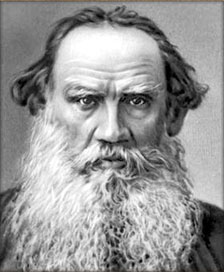
Tolstoy Lev Nikolaevich
(1828—1910s)