War and Peace
winter rye and the stubble. Again Erza and Milka were abreast, running like a pair of carriage horses, and began to overtake the hare, but it was easier for the hare to run on the balk and the borzois did not overtake him so quickly.“Rugay, Rugayushka! That’s it, come on!” came a third voice just then, and “Uncle’s” red borzoi, straining and curving its back, caught up with the two foremost borzois, pushed ahead of them regardless of the terrible strain, put on speed close to the hare, knocked it off the balk onto the ryefield, again put on speed still more viciously, sinking to his knees in the muddy field, and all one could see was how, muddying his back, he rolled over with the hare. A ring of borzois surrounded him. A moment later everyone had drawn up round the crowd of dogs. Only the delighted “Uncle” dismounted, and cut off a pad, shaking the hare for the blood to drip off, and anxiously glancing round with restless eyes while his arms and legs twitched. He spoke without himself knowing whom to or what about. “That’s it, come on! That’s a dog! . . . There, it has beaten them all, the thousand-ruble as well as the one-ruble borzois. That’s it, come on!” said he, panting and looking wrathfully around as if he were abusing someone, as if they were all his enemies and had insulted him, and only now had he at last succeeded in justifying himself. “There are your thousand-ruble ones. . . . That’s it, come on! . . .”
“Rugay, here’s a pad for you!” he said, throwing down the hare’s muddy pad. “You’ve deserved it, that’s it, come on!”
“She’d tired herself out, she’d run it down three times by herself,” said Nicholas, also not listening to anyone and regardless of whether he were heard or not.
“But what is there in running across it like that?” said Ilagin’s groom.
“Once she had missed it and turned it away, any mongrel could take it,” Ilagin was saying at the same time, breathless from his gallop and his excitement. At the same moment Natasha, without drawing breath, screamed joyously, ecstatically, and so piercingly that it set everyone’s ear tingling. By that shriek she expressed what the others expressed by all talking at once, and it was so strange that she must herself have been ashamed of so wild a cry and everyone else would have been amazed at it at any other time. “Uncle” himself twisted up the hare, threw it neatly and smartly across his horse’s back as if by that gesture he meant to rebuke everybody, and, with an air of not wishing to speak to anyone, mounted his bay and rode off. The others all followed, dispirited and shamefaced, and only much later were they able to regain their former affectation of indifference. For a long time they continued to look at red Rugay who, his arched back spattered with mud and clanking the ring of his leash, walked along just behind “Uncle’s” horse with the serene air of a conqueror.
“Well, I am like any other dog as long as it’s not a question of coursing. But when it is, then look out!” his appearance seemed to Nicholas to be saying.
When, much later, “Uncle” rode up to Nicholas and began talking to him, he felt flattered that, after what had happened, “Uncle” deigned to speak to him.
TOWARD EVENING Ilagin took leave of Nicholas, who found that they were so far from home that he accepted “Uncle’s” offer that the hunting party should spend the night in his little village of Mikhaylovna.
“And if you put up at my house that will be better still. That’s it, come on!” said “Uncle.” “You see it’s damp weather, and you could rest, and the little countess could be driven home in a trap.”
“Uncle’s” offer was accepted. A huntsman was sent to Otradnoe for a trap, while Nicholas rode with Natasha and Petya to “Uncle’s” house.
Some five male domestic serfs, big and little, rushed out to the front porch to meet their master. A score of women serfs, old and young, as well as children, popped out from the back entrance to have a look at the hunters who were arriving. The presence of Natasha—a woman, a lady, and on horseback—raised the curiosity of the serfs to such a degree that many of them came up to her, stared her in the face, and unabashed by her presence made remarks about her as though she were some prodigy on show and not a human being able to hear or understand what was said about her.
“Arinka! Look, she sits sideways! There she sits and her skirt dangles. . . . See, she’s got a little hunting horn!”
“Goodness gracious! See her knife? . . .”
“Isn’t she a Tartar!”
“How is it you didn’t go head over heels?” asked the boldest of all, addressing Natasha directly.
“Uncle” dismounted at the porch of his little wooden house which stood in the midst of an overgrown garden and, after a glance at his retainers, shouted authoritatively that the superfluous ones should take themselves off and that all necessary preparations should be made to receive the guests and the visitors.
The serfs all dispersed. “Uncle” lifted Natasha off her horse and taking her hand led her up the rickety wooden steps of the porch. The house, with its bare, unplastered log walls, was not overclean—it did not seem that those living in it aimed at keeping it spotless—but neither was it noticeably neglected. In the entry there was a smell of fresh apples, and wolf and fox skins hung about.
“Uncle” led the visitors through the anteroom into a small hall with a folding table and red chairs, then into the drawing room with a round birchwood table and a sofa, and finally into his private room where there was a tattered sofa, a worn carpet, and portraits of Suvorov, of the host’s father and mother, and of himself in military uniform. The study smelt strongly of tobacco and dogs. “Uncle” asked his visitors to sit down and make themselves at home, and then went out of the room. Rugay, his back still muddy, came into the room and lay down on the sofa, cleaning himself with his tongue and teeth. Leading from the study was a passage in which a partition with ragged curtains could be seen. From behind this came women’s laughter and whispers. Natasha, Nicholas, and Petya took off their wraps and sat down on the sofa. Petya, leaning on his elbow, fell asleep at once. Natasha and Nicholas were silent. Their faces glowed, they were hungry and very cheerful. They looked at one another (now that the hunt was over and they were in the house, Nicholas no longer considered it necessary to show his manly superiority over his sister), Natasha gave him a wink, and neither refrained long from bursting into a peal of ringing laughter even before they had a pretext ready to account for it.
After a while “Uncle” came in, in a Cossack coat, blue trousers, and small top boots. And Natasha felt that this costume, the very one she had regarded with surprise and amusement at Otradnoe, was just the right thing and not at all worse than a swallow-tail or frock coat. “Uncle” too was in high spirits and far from being offended by the brother’s and sister’s laughter (it could never enter his head that they might be laughing at his way of life) he himself joined in the merriment.
“That’s right, young countess, that’s it, come on! I never saw anyone like her!” said he, offering Nicholas a pipe with a long stem and, with a practiced motion of three fingers, taking down another that had been cut short. “She’s ridden all day like a man, and is as fresh as ever!”
Soon after “Uncle’s” reappearance the door was opened, evidently from the sound by a barefooted girl, and a stout, rosy, good-looking woman of about forty, with a double chin and full red lips, entered carrying a large loaded tray. With hospitable dignity and cordiality in her glance and in every motion, she looked at the visitors and, with a pleasant smile, bowed respectfully. In spite of her exceptional stoutness, which caused her to protrude her chest and stomach and throw back her head, this woman (who was “Uncle’s” housekeeper) trod very lightly. She went to the table, set down the tray, and with her plump white hands deftly took from it the bottles and various hors d’oeuvres and dishes and arranged them on the table. When she had finished, she stepped aside and stopped at the door with a smile on her face. “Here I am. I am she! Now do you understand ‘Uncle’?” her expression said to Rostov. How could one help understanding? Not only Nicholas, but even Natasha understood the meaning of his puckered brow and the happy complacent smile that slightly puckered his lips when Anisya Fedorovna entered. On the tray was a bottle of herb wine, different kinds of vodka, pickled mushrooms, rye cakes made with buttermilk, honey in the comb, still mead and sparkling mead, apples, nuts (raw and roasted), and nut-and-honey sweets. Afterwards she brought a freshly roasted chicken, ham, preserves made with honey, and preserves made with sugar.
All this was the fruit of Anisya Fedorovna’s housekeeping, gathered and prepared by her. The smell and taste of it all had a smack of Anisya Fedorovna herself: a savor of juiciness, cleanliness, whiteness, and pleasant smiles.
“Take
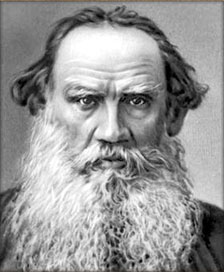
Tolstoy Lev Nikolaevich
(1828—1910s)