War and Peace
this, little Lady-Countess!” she kept saying, as she offered Natasha first one thing and then another.Natasha ate of everything and thought she had never seen or eaten such buttermilk cakes, such aromatic jam, such honey-and-nut sweets, or such a chicken anywhere. Anisya Fedorovna left the room.
After supper, over their cherry brandy, Rostov and “Uncle” talked of past and future hunts, of Rugay and Ilagin’s dogs, while Natasha sat upright on the sofa and listened with sparkling eyes. She tried several times to wake Petya that he might eat something, but he only muttered incoherent words without waking up. Natasha felt so lighthearted and happy in these novel surroundings that she only feared the trap would come for her too soon. After a casual pause, such as often occurs when receiving friends for the first time in one’s own house, “Uncle,” answering a thought that was in his visitors’ minds, said:
“This, you see, is how I am finishing my days . . . Death will come. That’s it, come on! Nothing will remain. Then why harm anyone?”
“Uncle’s” face was very significant and even handsome as he said this. Involuntarily Rostov recalled all the good he had heard about him from his father and the neighbors. Throughout the whole province “Uncle” had the reputation of being the most honorable and disinterested of cranks. They called him in to decide family disputes, chose him as executor, confided secrets to him, elected him to be a justice and to other posts; but he always persistently refused public appointments, passing the autumn and spring in the fields on his bay gelding, sitting at home in winter, and lying in his overgrown garden in summer.
“Why don’t you enter the service, Uncle?”
“I did once, but gave it up. I am not fit for it. That’s it, come on! I can’t make head or tail of it. That’s for you—I haven’t brains enough. Now, hunting is another matter—that’s it, come on! Open the door, there!” he shouted. “Why have you shut it?”
The door at the end of the passage led to the huntsmen’s room, as they called the room for the hunt servants.
There was a rapid patter of bare feet, and an unseen hand opened the door into the huntsmen’s room, from which came the clear sounds of a balalayka 1 on which someone, who was evidently a master of the art, was playing. Natasha had been listening to those strains for some time and now went out into the passage to hear better.
“That’s Mitka, my coachman. . . . I have got him a good balalayka. I’m fond of it,” said “Uncle.”
It was the custom for Mitka to play the balalayka in the huntsmen’s room when “Uncle” returned from the chase. “Uncle” was fond of such music.
“How good! Really very good!” said Nicholas with some unintentional superciliousness, as if ashamed to confess that the sounds pleased him very much.
“Very good?” said Natasha reproachfully, noticing her brother’s tone. “Not ‘very good’ it’s simply delicious!”
Just as “Uncle’s” pickled mushrooms, honey, and cherry brandy had seemed to her the best in the world, so also that song, at that moment, seemed to her the acme of musical delight.
“More, please, more!” cried Natasha at the door as soon as the balalayka ceased. Mitka tuned up afresh, and recommenced thrumming the balalayka to the air of My Lady, with trills and variations. “Uncle” sat listening, slightly smiling, with his head on one side. The air was repeated a hundred times. The balalayka was retuned several times and the same notes were thrummed again, but the listeners did not grow weary of it and wished to hear it again and again. Anisya Fedorovna came in and leaned her portly person against the doorpost.
“You like listening?” she said to Natasha, with a smile extremely like “Uncle’s.” “That’s a good player of ours,” she added.
“He doesn’t play that part right!” said “Uncle” suddenly, with an energetic gesture. “Here he ought to burst out—that’s it, come on!—ought to burst out.”
“Do you play then?” asked Natasha.
“Uncle” did not answer, but smiled.
“Anisya, go and see if the strings of my guitar are all right. I haven’t touched it for a long time. That’s it—come on! I’ve given it up.”
Anisya Fedorovna, with her light step, willingly went to fulfill her errand and brought back the guitar.
Without looking at anyone, “Uncle” blew the dust off it and, tapping the case with his bony fingers, tuned the guitar and settled himself in his armchair. He took the guitar a little above the fingerboard, arching his left elbow with a somewhat theatrical gesture, and, with a wink at Anisya Fedorovna, struck a single chord, pure and sonorous, and then quietly, smoothly, and confidently began playing in very slow time, not My Lady, but the well-known song: Came a maiden down the street. The tune, played with precision and in exact time, began to thrill in the hearts of Nicholas and Natasha, arousing in them the same kind of sober mirth as radiated from Anisya Fedorovna’s whole being. Anisya Fedorovna flushed, and drawing her kerchief over her face went laughing out of the room. “Uncle” continued to play correctly, carefully, with energetic firmness, looking with a changed and inspired expression at the spot where Anisya Fedorovna had just stood. Something seemed to be laughing a little on one side of his face under his gray mustaches, especially as the song grew brisker and the time quicker and when, here and there, as he ran his fingers over the strings, something seemed to snap.
“Lovely, lovely! Go on, Uncle, go on!” shouted Natasha as soon as he had finished. She jumped up and hugged and kissed him. “Nicholas, Nicholas!” she said, turning to her brother, as if asking him: “What is it moves me so?”
Nicholas too was greatly pleased by “Uncle’s” playing, and “Uncle” played the piece over again. Anisya Fedorovna’s smiling face reappeared in the doorway and behind hers other faces . . . played “Uncle” once more, running his fingers skillfully over the strings, and then he stopped short and jerked his shoulders.
Fetching water clear and sweet,
Stop, dear maiden, I entreat—
“Go on, Uncle dear,” Natasha wailed in an imploring tone as if her life depended on it.
“Uncle” rose, and it was as if there were two men in him: one of them smiled seriously at the merry fellow, while the merry fellow struck a naive and precise attitude preparatory to a folk dance.
“Now then, niece!” he exclaimed, waving to Natasha the hand that had just struck a chord.
Natasha threw off the shawl from her shoulders, ran forward to face “Uncle,” and setting her arms akimbo also made a motion with her shoulders and struck an attitude.
Where, how, and when had this young countess, educated by an emigree French governess, imbibed from the Russian air she breathed that spirit and obtained that manner which the pas de chale 2 would, one would have supposed, long ago have effaced? But the spirit and the movements were those inimitable and unteachable Russian ones that “Uncle” had expected of her. As soon as she had struck her pose, and smiled triumphantly, proudly, and with sly merriment, the fear that had at first seized Nicholas and the others that she might not do the right thing was at an end, and they were already admiring her.
She did the right thing with such precision, such complete precision, that Anisya Fedorovna, who had at once handed her the handkerchief she needed for the dance, had tears in her eyes, though she laughed as she watched this slim, graceful countess, reared in silks and velvets and so different from herself, who yet was able to understand all that was in Anisya and in Anisya’s father and mother and aunt, and in every Russian man and woman.
“Well, little countess; that’s it—come on!” cried “Uncle,” with a joyous laugh, having finished the dance. “Well done, niece! Now a fine young fellow must be found as husband for you. That’s it—come on!”
“He’s chosen already,” said Nicholas smiling.
“Oh?” said “Uncle” in surprise, looking inquiringly at Natasha, who nodded her head with a happy smile.
“And such a one!” she said. But as soon as she had said it a new train of thoughts and feelings arose in her. “What did Nicholas’ smile mean when he said ‘chosen already’? Is he glad of it or not? It is as if he thought my Bolkonski would not approve of or understand our gaiety. But he would understand it all. Where is he now?” she thought, and her face suddenly became serious. But this lasted only a second. “Don’t dare to think about it,” she said to herself, and sat down again smilingly beside “Uncle,” begging him to play something more.
“Uncle” played another song and a valse; then after a pause he cleared his throat and sang his favorite hunting song:
As ’twas growing dark last night
Fell the snow so soft and light . . .
“Uncle” sang as peasants sing, with full and naive conviction that the whole meaning of a song lies in the words and that the tune comes of itself, and that apart from the words there is no tune, which exists only to give measure to the words. As a result of this the unconsidered tune, like the song of a bird, was extraordinarily good. Natasha was in ecstasies over “Uncle’s” singing. She resolved to give up learning the harp and to play only the guitar. She asked “Uncle” for his guitar and at once found the chords of the song.
After nine o’clock two traps and three mounted men, who had been sent to look for
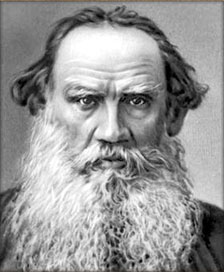
Tolstoy Lev Nikolaevich
(1828—1910s)